Blog

  • How Close to a Fire Hydrant Can You Park NYC: Official 2026 Rules

    How Close to a Fire Hydrant Can You Park NYC: Official 2026 Rules

    NYC issues over 10 million parking tickets annually, and fire hydrant violations rank among the most common, and most expensive, mistakes drivers make. Understanding exactly how close to a fire hydrant can you park NYC is not optional; it’s essential to avoid $115 fines and potential towing.

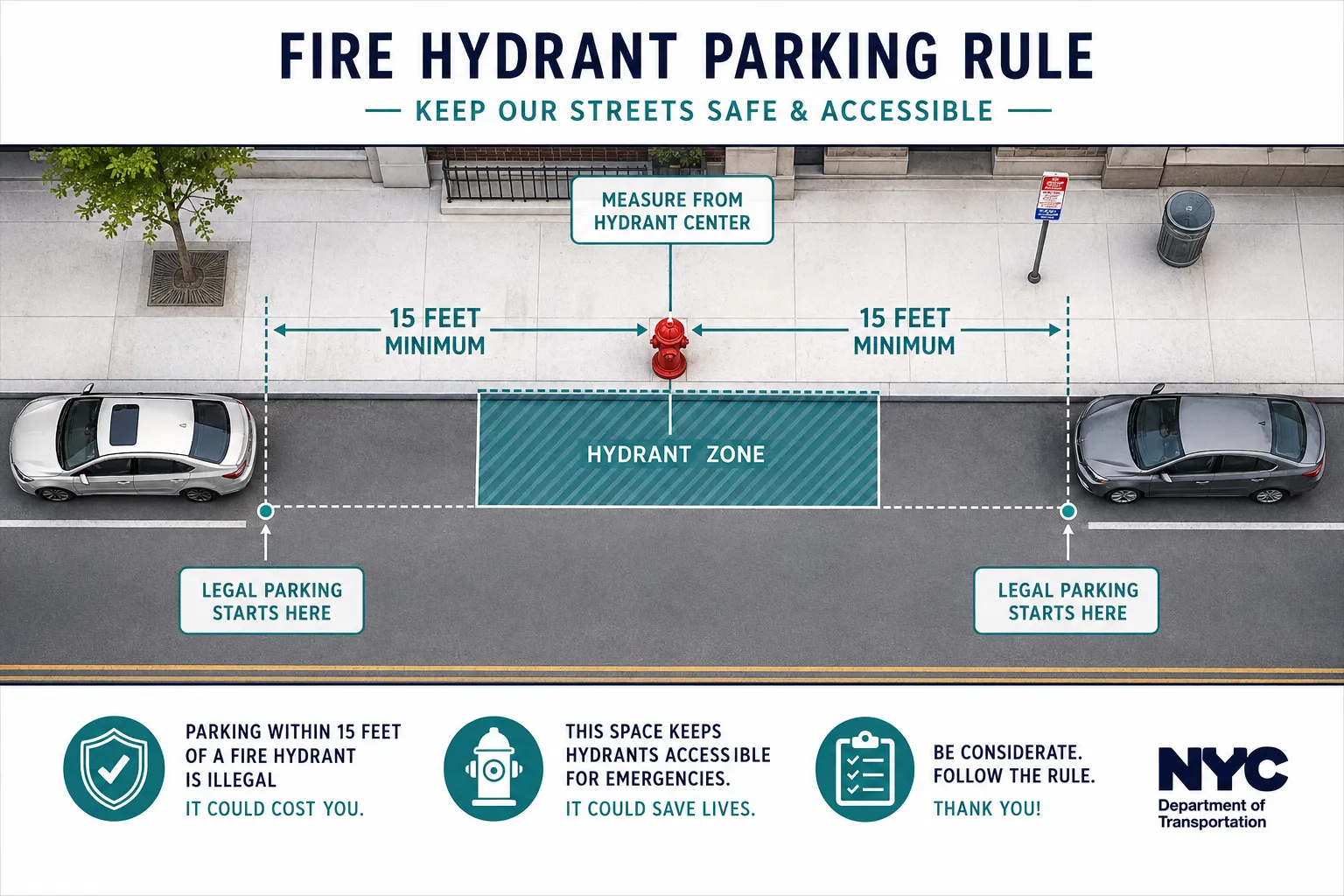
    The official rule is absolute: 15 feet minimum distance from any fire hydrant, measured from the hydrant itself to the nearest part of your vehicle, on both sides of the hydrant, 24/7. This applies across all five boroughs and overrides painted curb markings, which are often faded or misleading.[1][2]

    Key Takeaways

    • NYC law prohibits parking within 15 feet of a fire hydrant on either side, before or after the hydrant, citywide, including floating parking lanes next to protected bike lanes.
    • The 15-foot buffer equals approximately 4.6 meters, roughly one to one-and-a-half car lengths, or five to six walking paces.
    • A limited daylight «standing» exception allows passenger cars to remain at a hydrant only if the driver stays in the operator’s seat, engine running, ready to move instantly, not true parking.
    • Violation code 40 carries a standard fine of approximately $115 in 2026, and enforcement is strict regardless of curb paint condition.
    • Measure distance from the hydrant center to your vehicle’s nearest point (typically front or rear bumper corner), not from painted curb lines.

    Official NYC Fire Hydrant Parking Distance: The 15-Foot Rule

    NYC Traffic Rules §4-08 establishes the legal standard: stopping, standing, or parking within fifteen feet of a fire hydrant is prohibited.[5] This distance applies to both the approach side and the departure side of the hydrant, drivers must leave at least 15 feet clear before the hydrant and at least 15 feet after it.[3][10]
    Official NYC Fire Hydrant Parking Distance: The 15-Foot Rule

    The NYC Department of Transportation’s 2026 parking regulations page, updated in late August, explicitly confirms the 15-foot rule remains in effect citywide, including newer street designs such as protected bike lanes with floating parking lanes.[2] The rule has been codified since at least January 2025 and has not been modified in subsequent updates through mid-2026.[5][2]

    Measure from the hydrant itself, not curb paint. Many drivers mistakenly rely on yellow painted curb zones around hydrants to judge legal parking boundaries. Official guidance warns that painted curbs are not the legal standard, the 15-foot measurement always controls, even where paint is missing, faded, or inaccurate.[1][8] Calculate distance from the hydrant’s physical location to the closest part of your vehicle, typically the front or rear bumper corner.[8][7]

    For quick street-level estimation, 15 feet equals roughly:

    • 4.6 meters (metric)
    • One to one-and-a-half car lengths (depending on vehicle size)
    • Five to six normal walking paces (adult stride)[8][7]

    The rule applies 24 hours a day, seven days a week, with only a narrow daylight exception discussed below.[6][3]

    Understanding the Daylight Standing Exception (Not a Parking Permit)

    NYC Traffic Rules §4-08 includes a specific exception that confuses many drivers: a passenger car may stand (not park) directly next to a fire hydrant during daylight hours, sunrise to sunset, under strict conditions.[5][6]

    All four conditions must be met simultaneously:

    1. Standing is otherwise permitted at that location.
    2. The driver remains in the operator’s seat at all times.
    3. The engine is running and ready for immediate operation.
    4. The vehicle is moved instantly upon approach of fire apparatus or instruction from police, fire, or traffic officials.[5][3]

    Practical enforcement guidance stresses this is not permission to park and leave your car, even briefly.[6][10][12] If you exit the vehicle, lock the doors, or walk away, even for 30 seconds, you are parked, not standing, and the 15-foot rule applies in full.[6][3] Ticket-defense experts report that many hydrant violations occur when drivers misinterpret this exception and step out «just for a minute» within the buffer zone.[10][12]

    For practical purposes, treat the 15-foot rule as a strict no-parking zone 24/7. Any unattended vehicle within that buffer is subject to violation code 40, regardless of time of day.[6][12][3]

    How to Measure 15 Feet Accurately on NYC Streets

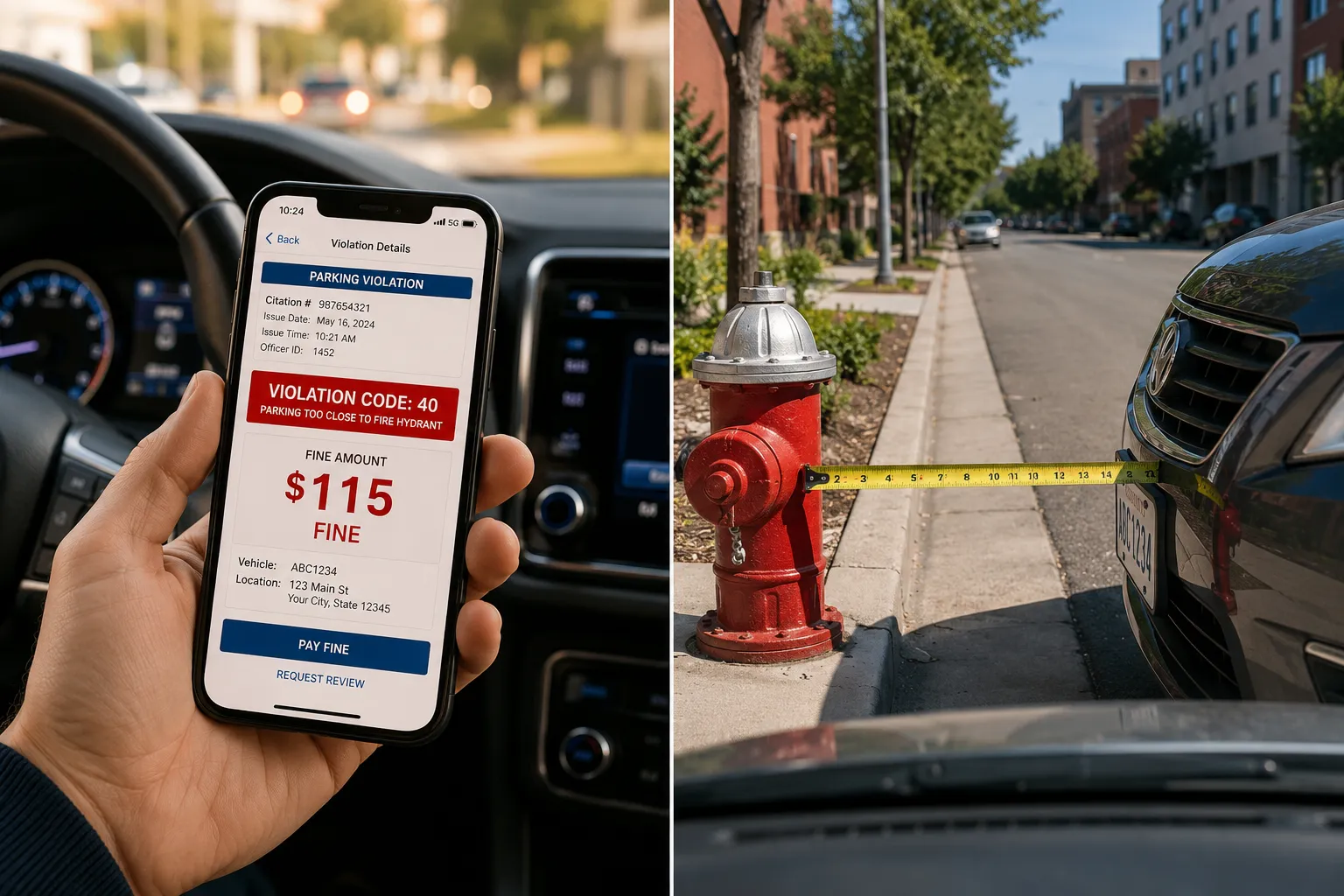
    Enforcement measures from the hydrant center to the nearest part of your vehicle,not to your tires, not to the car’s center, and not from painted lines.[8][7] The nearest point is usually the front bumper corner (when parking ahead of a hydrant) or the rear bumper corner (when parking behind a hydrant).[8]

    Quick measurement methods:

    • Walking paces: Take five to six normal adult strides from the hydrant to your bumper. If you reach your car in fewer than five paces, you’re too close.[8][7]
    • Car-length rule: Leave at least one full car length (preferably one and a half) between the hydrant and your vehicle.[8]
    • Tape measure (most accurate): Carry a small measuring tape or use a smartphone app to confirm 15 feet (180 inches or 4.6 meters) before committing to a spot.[8][7]

    Both sides matter equally. The 15-foot buffer extends in both directions along the curb. Drivers often assume the space immediately after a hydrant (in the direction of traffic) is safer or less enforced, it is not.[3][10] Enforcement applies symmetrically on both the approach and departure sides.[10][13]

    When evaluating a curb space, also check for other distance restrictions that commonly overlap with hydrant zones:

    • 20 feet from crosswalk areas (measured from the nearest edge of the crosswalk)
    • 30 feet from stop signs or traffic signals on the approach side[11]

    If a potential parking spot is near a hydrant and also close to a crosswalk or stop sign, you must satisfy all applicable distance rules simultaneously.[11]
    How to Measure 15 Feet Accurately on NYC Streets

    Fire Hydrant Parking Violations: Fines, Enforcement, and Real-Time Status

    Parking within 15 feet of a fire hydrant is classified as NYC parking violation code 40.[9][6] As of 2026, the standard fine for this violation is approximately $115.[9][12] Hydrant tickets are among the most common and rigorously enforced parking infractions citywide, with traffic enforcement agents and NYPD officers issuing them frequently.[9][12][6]

    Why enforcement is strict: Firefighters require unobstructed access and clearance to connect hoses and operate equipment during emergencies. Even partial obstruction, such as parking close enough that hoses must be routed awkwardly, can delay response times, which is why the city maintains low tolerance for any vehicle in the hydrant zone.[3][14][6]

    Check Real-Time Status and Suspension Calendars: While the 15-foot hydrant rule itself does not suspend for holidays or street cleaning, Alternate Side Parking regulations do. If you’re navigating complex parking rules in neighborhoods like Park Slope, Astoria, Williamsburg, DUMBO, or Greenpoint, use real-time suspension calendars to confirm whether Alternate Side Parking is in effect today. This helps you avoid layering a hydrant violation on top of an ASP ticket.

    Unfair parking citations and disputes: If you believe you received a hydrant ticket in error, for example, if you have photographic evidence showing your vehicle was more than 15 feet away, consult resources on Tickets & Disputes for step-by-step guidance on contesting the citation. Document the scene with photos showing the hydrant, your vehicle position, and measurements before moving your car.

    Towing & Impounds: Vehicles parked illegally at hydrants are subject to towing, especially in high-traffic or emergency-response corridors. If your car has been towed, visit Towing & Impounds resources immediately to locate your vehicle and understand recovery procedures.

    Off-Street Parking Alternatives Across NYC Boroughs

    When street parking near fire hydrants or in congested neighborhoods becomes too risky or time-consuming, off-street parking garages and lots offer predictable, legal alternatives. Explore the NYC Parking Directory to find facilities across all five boroughs, compare rates, and secure spots in advance.

    Borough-specific garage options:

    Parking Education Hub: For comprehensive guides on garage savings, rate comparisons, and strategies to reduce parking costs, visit the Parking Garages & Savings section of the Parking Education Hub.

    Conclusion

    Understanding how close to a fire hydrant can you park NYC is straightforward: 15 feet minimum, measured from the hydrant to your vehicle’s nearest point, on both sides, at all times. Do not rely on curb paint, do not assume the daylight exception applies if you leave the vehicle, and do not risk a $115 fine by guessing distances.

    Actionable next steps:

    • Measure accurately: Use walking paces (five to six strides) or a car-length estimate (one to one-and-a-half lengths) before committing to a curb spot.
    • Check Real-Time Status: Confirm Alternate Side Parking suspensions and street cleaning schedules in your neighborhood to layer compliance across all parking rules.
    • Explore Off-Street Options: When street parking is too uncertain, locate and compare garages via the NYC Parking Directory.
    • Fight Unfair Citations: If you receive an incorrect hydrant ticket, document the scene and consult Tickets & Disputes resources immediately.
    • Stay Informed: Bookmark suspension calendars and real-time alerts to avoid fines and towing across all NYC boroughs.

    Avoid fines and towing by treating the 15-foot hydrant rule as non-negotiable. Locate your vehicle with confidence, check status in real time, and use the Parking Education Hub to navigate NYC’s complex parking landscape successfully in 2026.

    References

    [1] Article – https://portal.311.nyc.gov/article/?kanumber=KA-01026 [2] Parking Regulations – https://www.nyc.gov/html/dot/html/motorist/parking-regulations.shtml [3] Nyc Fire Hydrant Parking Distance – https://www.spotlink.app/nyc-fire-hydrant-parking-distance [5] 0 0 0 63770 – https://codelibrary.amlegal.com/codes/newyorkcity/latest/NYCrules/0-0-0-63770 [6] No Nonsense Guide To Nyc Fire Hydrant Rule – https://newyorkparkingticket.com/no-nonsense-guide-to-nyc-fire-hydrant-rule/ [7] In New York City How Far From A Fire Hydrant Can You Legally Park A Hire Car – https://holacarrentals.com/blogs/car-rental-united-states/in-new-york-city-how-far-from-a-fire-hydrant-can-you-legally-park-a-hire-car [8] How Close Can You Legally Park To A Fire Hydrant In New York And How Do You Measure It Quickly – https://holacarrentals.com/blogs/car-rental-united-states/how-close-can-you-legally-park-to-a-fire-hydrant-in-new-york-and-how-do-you-measure-it-quickly [9] Hydrant Parking Nyc – https://www.spotlink.app/hydrant-parking-nyc [10] Can You Park Near Fire Hydrant Nyc – https://www.spotlink.app/blog/can-you-park-near-fire-hydrant-nyc [12] No Nonsense Guide To Nyc Fire Hydrant Rule – https://newyorkparkingticket.com/no-nonsense-guide-to-nyc-fire-hydrant-rule/ [13] Can You Park Near Fire Hydrant Nyc – https://www.spotlink.app/blog/can-you-park-near-fire-hydrant-nyc [14] Nyc Fire Hydrant Parking Distance – https://www.spotlink.app/nyc-fire-hydrant-parking-distance
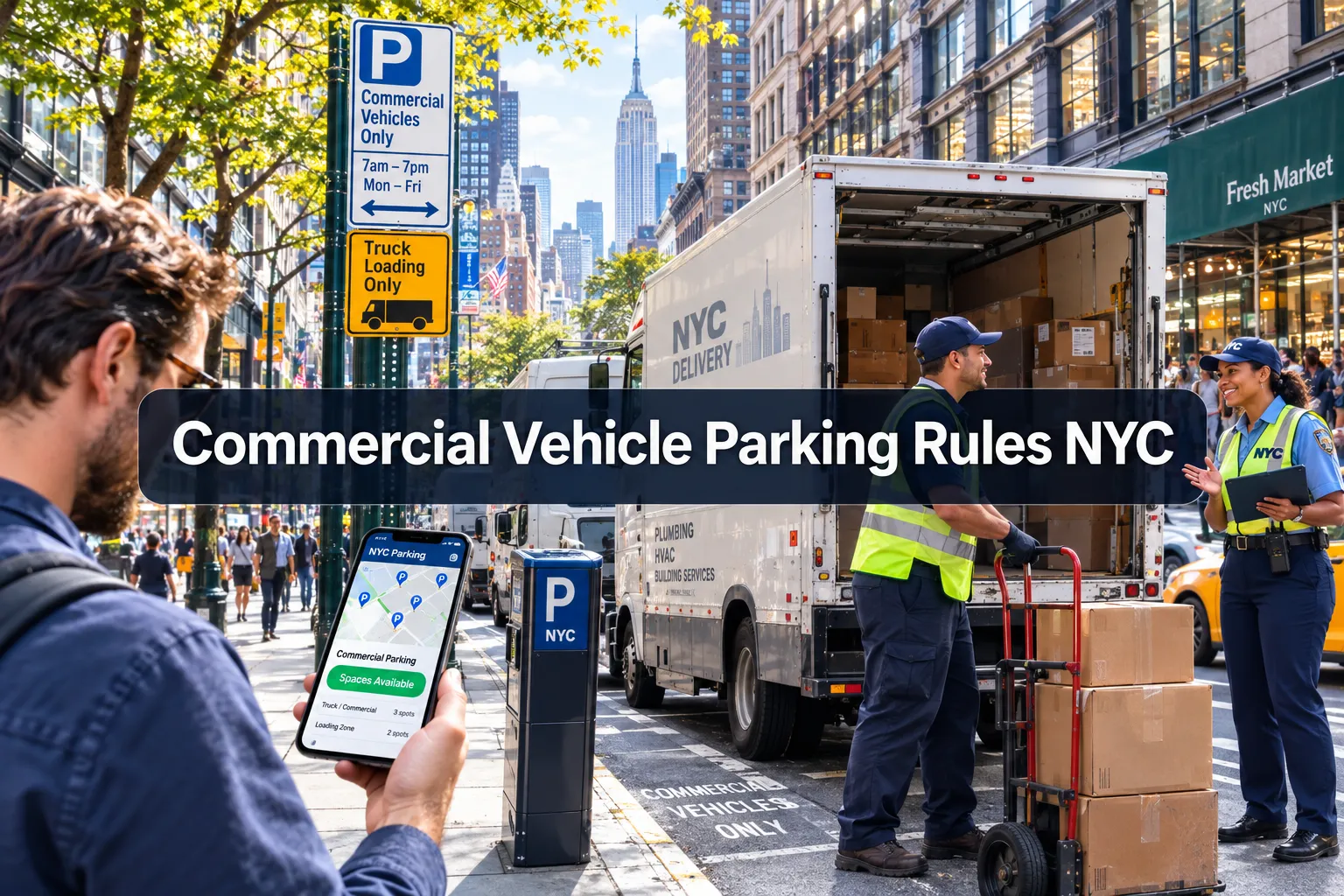
  • Commercial Vehicle Parking Rules NYC: Official 2026 Guide to Avoiding Fines and Towing

    Commercial Vehicle Parking Rules NYC: Official 2026 Guide to Avoiding Fines and Towing

    NYC issues over 10 million parking tickets annually, and commercial vehicle violations account for a substantial share. One wrong move, parking your work van overnight on a residential block or exceeding the three-hour limit, can cost you $115 or more, plus towing fees that spiral into the hundreds. Understanding commercial vehicle parking rules NYC is not optional for delivery drivers, contractors, and fleet operators working in the five boroughs in 2026.

    This guide breaks down the official regulations, real-time enforcement tools, and new pilot programs that govern where and when you can legally park a commercial vehicle in New York City. Whether you drive a box truck, a cargo van, or a tractor-trailer, these rules determine whether you wake up to a clear windshield or a citation, and knowing them can save you thousands in fines and lost time.

    Key Takeaways

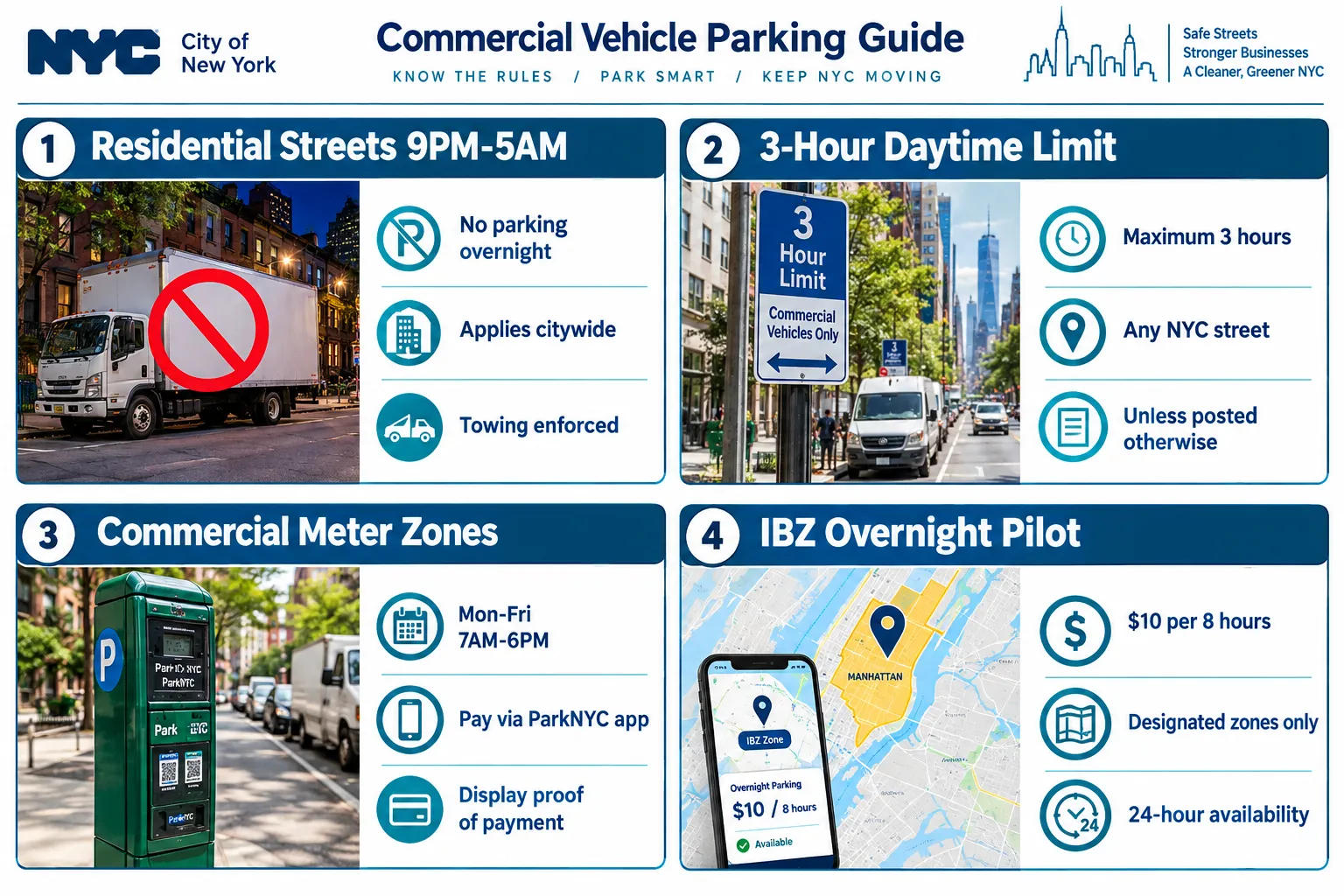
    • Commercial vehicles may not park on any NYC street for more than three hours unless signs permit otherwise, and overnight parking on residential streets (9 p.m. to 5 a.m.) is prohibited citywide.
    • New metered overnight truck parking zones in Industrial Business Zones (IBZs) across Brooklyn, the Bronx, and Queens allow 8-hour sessions for $10 via the ParkNYC app, operating 24 hours Monday through Saturday.
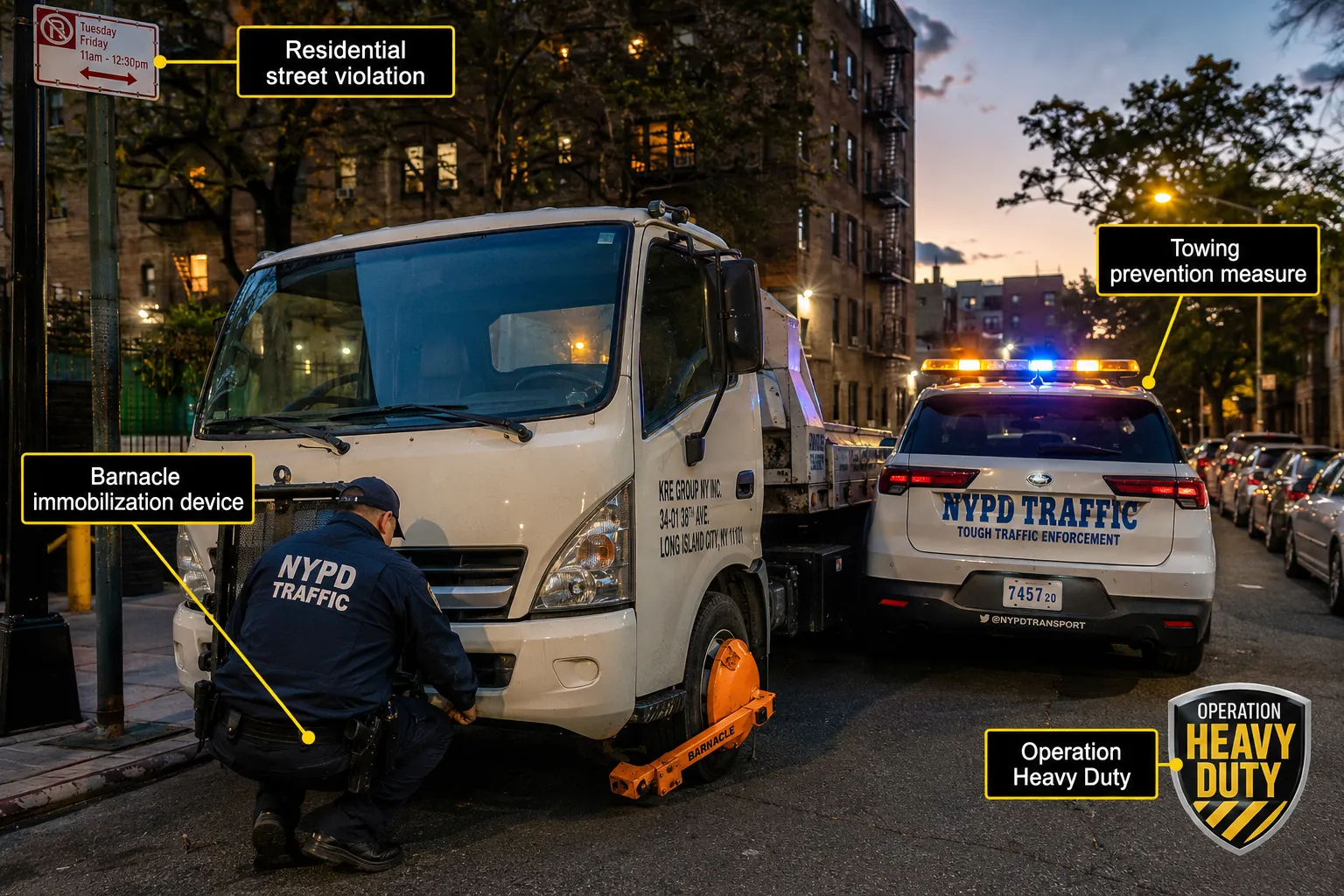
    • NYPD enforcement has intensified with Operation Heavy Duty and deployment of the Barnacle windshield boot, targeting illegal overnight and residential truck parking.
    • More than 500 new curbside commercial loading zones have been installed citywide to reduce double-parking, while automated camera enforcement on MTA buses captures violations in real time.
    • Check real-time Alternate Side Parking status and suspension calendars to coordinate commercial deliveries and avoid street-sweeping tickets during ASP windows.

    Understanding NYC’s Core Commercial Vehicle Parking Restrictions

    NYC Administrative Code §19-170 establishes two foundational rules that apply to every commercial vehicle in the city. First, commercial vehicles may not park anywhere in NYC for more than three hours when parking is not otherwise restricted. Second, commercial vehicles are prohibited from parking on residential streets between 9 p.m. and 5 a.m.,a ban that remains in force across all five boroughs as of 2026.[1][2]

    These provisions form the backbone of enforcement. A «commercial vehicle» under NYC Traffic Rules §4-08 includes any vehicle designed, maintained, or used primarily for the transportation of property, or any vehicle with commercial plates. Box trucks, cargo vans, tractor-trailers, and even pickup trucks with commercial registration fall under these restrictions.[4]

    Key restrictions at a glance:

    • Three-hour limit: Applies citywide on any street where parking is not otherwise prohibited. Exceeding three hours triggers a violation even if you paid a meter or parked legally at the start.
    • Overnight residential ban: From 9 p.m. to 5 a.m., no commercial vehicle may park on a residential street. Enforcement is active every night, and violations carry fines starting at $115 plus potential towing.
    • Midtown Manhattan rules: Between 14th and 60th Streets, from 1st to 12th Avenues, commercial vehicles must park parallel within 12 inches of the curb and may not occupy more than 10 feet of roadway width.[4]
    • No street storage: NYC prohibits using public streets as storage for unaltered commercial vehicles, meaning you cannot leave a truck parked in one spot indefinitely, even during permitted hours.
    Understanding NYC's Core Commercial Vehicle Parking Restrictions

    These rules remain unchanged from their December 2024 codification and are cited by NYPD and the Department of Finance when issuing summonses.[1][4] Drivers who rely on street parking for work vehicles must plan around the three-hour cap and find off-street or designated zones for overnight storage.

    For general guidance on Alternate Side Parking rules in NYC, including how ASP interacts with commercial vehicle restrictions, consult our comprehensive ASP guide.

    Where Commercial Vehicles Can Park Legally: Meters, Loading Zones, and IBZ Pilots

    NYC has expanded legal parking options for commercial vehicles in 2026 through a combination of metered zones, dedicated loading areas, and pilot programs in Industrial Business Zones.

    Commercial Meter Zones and Pay-by-App Spaces

    In «No Standing Commercial Vehicles Only» metered zones, commercial vehicles can park Monday through Friday from 7 a.m. to 6 p.m. for up to three hours per block after paying at a meter or via the ParkNYC mobile app and displaying proof of payment.[5][6] These zones are marked with green or white «Commercial Vehicles Only» signs and are typically located in commercial corridors.

    NYC DOT has also launched pay-by-app-only commercial meters on specific corridors, including Sixth Avenue between West 14th and West 23rd Streets in Manhattan. Drivers must use the ParkNYC app to pay; coin or card payment at physical meters is not accepted in these pilot areas.[3]

    Overnight Truck Parking Pilot in Industrial Business Zones

    Launched in March 2025, the Overnight Truck Parking Pilot created approximately 45 metered commercial vehicle spaces across three IBZ corridors:[3][7][8]

    • Flatlands/Fairfield, Brooklyn: Flatlands Avenue between Erskine Street and Fountain Avenue
    • Hunts Point, Bronx: Ryawa Avenue between Manida Street and Halleck Street
    • Maspeth, Queens: 56th Road between 43rd Street and 49th Street

    Truck operators pay $10 for each 8-hour session via the ParkNYC app. Parking is available 24 hours a day, Monday through Saturday, with no payment required on Sundays. The pilot runs for one year and aims to reduce illegal overnight truck parking on residential streets.[3][7][8]

    If you’re seeking off-street parking in the Bronx, explore garage options such as MPG Parking or Quik Park to avoid street restrictions entirely.

    City Council-Mandated IBZ Overnight Truck Parking Program

    Separate from the metered pilot, NYC Council legislation (Intro 99-A/99-B, adopted in 2025) requires DOT to establish curbside overnight truck parking areas within each IBZ, with parking allowed for up to 10 continuous hours between 8 p.m. and 6 a.m.[9][4] Non-commercial vehicles are prohibited in these zones during overnight hours. This program carries a five-year sunset and is designed to transform the initial pilot into a broader, time-limited policy across industrial areas citywide.[9]

    Industry coverage notes that the Council-mandated overnight curbside program focuses on «overnight-only» spaces inactive between 8 a.m. and 6 p.m., distinct from the 24-hour metered pilot.[7][9] However, a 2025 analysis by THE CITY found that the pilot did not cover several neighborhoods most heavily impacted by illegal truck parking, including parts of southeast Queens, fueling calls for expansion.[3]

    New Curbside Loading Zones

    NYC DOT has installed more than 500 new curbside loading zones citywide to address double-parking and blocked bus and bike lanes.[5][10] These zones reflect community feedback on freight activity hot spots and provide legal short-term parking for commercial deliveries. Loading zones are typically time-limited (15 to 30 minutes) and marked with «Loading Zone» signs; drivers must move vehicles promptly after unloading.

    For parking in Queens, including neighborhoods like Astoria and Flushing, check garage availability to supplement street options during peak delivery hours.

    Enforcement Escalation: Operation Heavy Duty, the Barnacle Boot, and Automated Cameras

    NYPD and NYC DOT have ramped up enforcement of commercial vehicle parking rules NYC since 2024, deploying new tools and operations to deter illegal overnight and residential truck parking.

    Operation Heavy Duty Enforcement

    Launched in 2024 and continuing through 2026, Operation Heavy Duty targets illegally parked trucks in Queens and other boroughs. NYPD reports issuing hundreds of summonses and conducting dozens of truck tows under this initiative.[9] Enforcement focuses on residential streets during the 9 p.m. to 5 a.m. ban and on trucks exceeding the three-hour daytime limit.

    The Barnacle Windshield Boot

    NYPD has deployed the Barnacle, a large orange suction-cup device that immobilizes vehicles by covering the windshield, to enforce commercial vehicle violations.[9] The Barnacle is applied to trucks with excessive unpaid fines or those parked illegally overnight on residential streets. Removal requires payment of outstanding fines and a release fee, and attempting to remove the device without authorization can result in additional penalties.

    The Barnacle Windshield Boot

    This tool signals a policy shift away from informal tolerance toward strict enforcement of the overnight residential ban.[2][9]

    Automated Camera Enforcement (ACE) Program

    NYC DOT’s Automated Camera Enforcement (ACE) program uses cameras mounted on over 1,000 MTA buses to capture double-parking violations and bus lane obstructions, many involving commercial vehicles, and forward them to DOT for processing.[7][10] Violations are issued automatically, and fines are mailed to the registered owner. The program has expanded significantly in 2025-2026, increasing the likelihood that illegal parking will be detected even in the absence of a traffic agent.

    Stipulated Fine Program Adjustments

    The Department of Finance’s Annual Parking Tickets and Camera Violations report (Local Law 6 report for FY25) documents changes to the Stipulated Fine Program, which allows commercial fleets to enroll and pay reduced fines for certain violations.[10] However, Streetsblog NYC highlighted that reduced stipulated fines for double-parking (dropping from $80 to $65 for enrolled firms) and bus lane parking might unintentionally encourage double-parking by commercial vehicles rather than curb it.[1]

    Drivers and fleet managers should weigh the cost of fines against the cost of securing legal off-street parking in Manhattan or other boroughs to avoid repeat violations and escalating penalties.

    Real-Time Alternate Side Parking Status and Commercial Vehicle Coordination

    Alternate Side Parking (ASP) rules intersect with commercial vehicle parking rules NYC in critical ways. During ASP windows, typically 8 a.m. to 11 a.m. or 11:30 a.m. to 2 p.m. on designated days, streets are cleared for sweeping, and parking is prohibited on the affected side. Commercial vehicles parked during ASP enforcement are ticketed and may be towed, just like passenger cars.

    Check real-time ASP status to coordinate deliveries and avoid violations. Park Rules Live provides live ASP suspension alerts for neighborhoods across NYC, including Astoria, Williamsburg, Park Slope, DUMBO, and Greenpoint. Use these tools to confirm whether ASP is suspended due to holidays or emergency declarations before parking a commercial vehicle on a residential block.

    Key ASP coordination tips for commercial drivers:

    • Plan around ASP windows: Schedule deliveries and pickups outside ASP enforcement hours to avoid moving your vehicle mid-shift.
    • Use suspension calendars: Official holiday suspension calendars list days when ASP is not in effect, allowing you to park legally on both sides of the street.
    • Monitor real-time alerts: Weather emergencies, snow operations, and special events can trigger ASP suspensions. Check Park Rules Live’s real-time status tracker for up-to-the-minute updates.
    • Understand block-specific schedules: ASP schedules vary by block. Read posted signs carefully and confirm the schedule for the exact block where you plan to park.

    For cities beyond NYC, including Yonkers, Buffalo, and Binghamton, consult city-specific ASP guides to coordinate commercial parking with local street-cleaning rules.

    Proposed Legislation and Future Expansions

    NYC lawmakers continue to introduce bills aimed at curbing illegal truck parking and expanding legal options for commercial vehicles. Proposed measures in 2025-2026 include:[3]

    • 90-minute citywide parking limit for large commercial vehicles such as trailers and semis, further restricting long-term street parking.
    • Requirements for DOT to establish overnight parking areas for large commercial vehicles within IBZs, operating from 8 p.m. to 6 a.m., building on the existing pilot.
    • Mandates for at least three off-street truck parking facilities citywide by early 2026, to be acquired and managed by a designated city agency.

    These proposals reflect ongoing tension between the need for commercial vehicle access and community complaints about illegal truck parking. Drivers should monitor legislative updates and adjust parking strategies as new rules take effect.

    Avoiding Fines, Towing, and Unfair Parking Citations

    Avoid fines and towing by following these best practices:

    1. Never park a commercial vehicle on a residential street overnight. The 9 p.m. to 5 a.m. ban is enforced citywide, and violations carry fines starting at $115 plus towing fees.
    2. Respect the three-hour limit. Even if you paid a meter or parked legally at the start, exceeding three hours triggers a violation. Set a timer and move your vehicle before the limit expires.
    3. Use designated IBZ overnight zones. If you need overnight parking, use the metered pilot zones in Flatlands, Hunts Point, or Maspeth, or explore off-street parking options in your borough.
    4. Pay meters and display proof. In commercial meter zones, always pay via the ParkNYC app or at the meter and display your receipt or confirmation on the dashboard.
    5. Check ASP status before parking. Use real-time suspension calendars and alerts to confirm whether ASP is in effect on the block where you plan to park.
    6. Fight unfair parking citations. If you receive a ticket you believe is incorrect, use the NYC Parking Education Hub resources on tickets and disputes to challenge the citation. Document your parking location, time, and any relevant signs with photos.

    For additional support on tickets and disputes, consult guides on contesting unfair parking citations and recovering towed vehicles through the city’s impound system.

    Conclusion

    Navigating commercial vehicle parking rules NYC in 2026 requires vigilance, planning, and real-time information. The three-hour daytime limit and overnight residential ban remain strictly enforced, while new metered IBZ zones and expanded loading areas offer legal alternatives for drivers willing to pay and plan ahead. NYPD’s Operation Heavy Duty, the Barnacle boot, and automated camera enforcement have raised the stakes for violations, making compliance essential to avoid fines and towing.

    Take action now:

    • Check real-time ASP status on Park Rules Live before parking on any residential block.
    • Explore off-street parking in Brooklyn, Manhattan, the Bronx, Queens, and Staten Island to secure legal overnight storage.
    • Use the ParkNYC app to pay for metered commercial zones and IBZ overnight pilot spaces.
    • Set reminders to move your vehicle before the three-hour limit expires.
    • Monitor suspension calendars and real-time alerts to coordinate deliveries around ASP enforcement.

    By understanding the rules, leveraging official tools, and staying informed on enforcement trends, commercial drivers can avoid costly citations, protect their vehicles from towing and impounds, and keep their operations running smoothly in the nation’s most complex parking environment.

    References

    [1] A Fine Mess City To Expand Encouragement For Truckers To Double Park – https://nyc.streetsblog.org/2024/10/22/a-fine-mess-city-to-expand-encouragement-for-truckers-to-double-park

    [2] New York City Creates Pilot Program For Three Truck Parking Lots – https://www.truckersnews.com/news/article/15740890/new-york-city-creates-pilot-program-for-three-truck-parking-lots

    [3] Pols Aim To Put Brakes On Illegal Truck Parking – https://queenseagle.com/all/2024/10/15/pols-aim-to-put-brakes-on-illegal-truck-parking

    [4] New York City Passes Bill To Expand Overnight Truck Parking – https://landline.media/new-york-city-passes-bill-to-expand-overnight-truck-parking/

    [5] Nyc Dot Loading Zones – https://www.nyc.gov/html/dot/html/pr2024/nyc-dot-loading-zones.shtml

    [6] 0099 2024+ – https://intro.nyc/0099-2024+

    [7] Nyc Advances Commonsense Solution To Address Truck Parking – https://landline.media/magazine/nyc-advances-commonsense-solution-to-address-truck-parking/

    [8] Mondays Headlines You Aint Goin Nowhere Edition – https://nyc.streetsblog.org/2024/04/08/mondays-headlines-you-aint-goin-nowhere-edition

    [9] Mayor Eric Adams Nypd Launch Crackdown On Commercial Vehicles Parking Illegally In Queens – https://www.cbsnews.com/newyork/news/mayor-eric-adams-nypd-launch-crackdown-on-commercial-vehicles-parking-illegally-in-queens/

    [10] Legislationdetail – https://legistar.council.nyc.gov/LegislationDetail.aspx?GUID=E10D907C-092A-4BFF-8FB5-BACB2CB71AE7&ID=6509477

  • How to Find a Hotel with Free Parking NYC in 2026

    How to Find a Hotel with Free Parking NYC in 2026

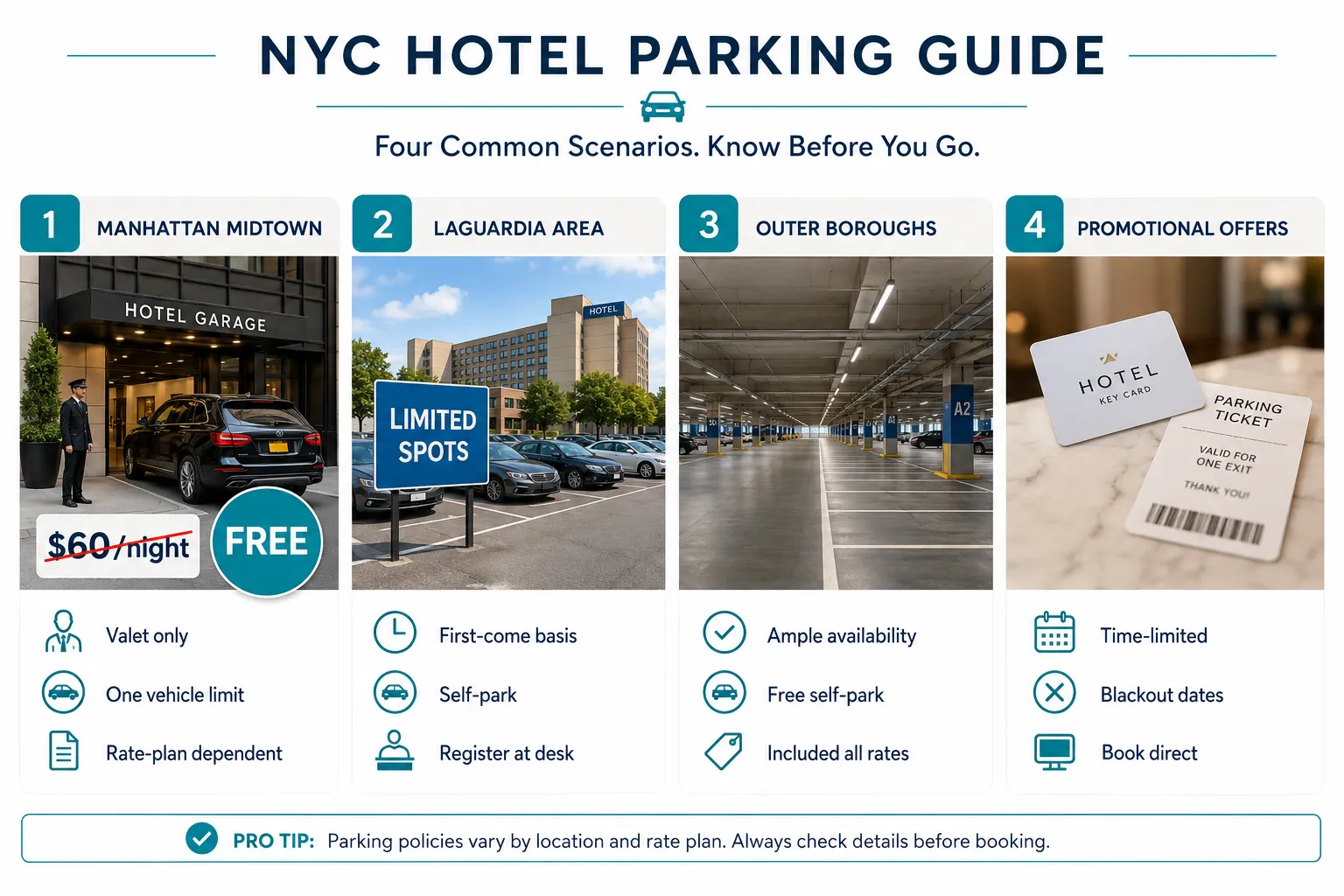
    New York City parking costs average $60 per night at most hotels, but a growing number of properties now advertise genuinely free parking as part of the room rate. As of August 2026, major booking platforms list approximately 279 hotels with free parking across the five boroughs, though availability, vehicle limits, and rate-plan restrictions apply at nearly every property.[5] Understanding where to find a hotel with free parking NYC and how to navigate the fine print can save hundreds of dollars on multi-night stays while eliminating the stress of Alternate Side Parking enforcement and meter feeding.

    Key Takeaways

    • Major booking platforms now maintain dedicated filters for hotels with free parking in NYC, with roughly 279 properties advertising some form of complimentary parking as of August 2026.[5]
    • Average nightly rates for NYC hotels with free parking run about $443, though deals as low as $68 have been recorded in the past week; Monday nights average $88 while Friday nights jump to $174.[5]
    • Most «free parking» offers come with significant constraints: one vehicle per room, no in-out privileges, vehicle-size restrictions, blackout dates, and first-come-first-served availability.
    • Properties offering free parking cluster in outer boroughs, near airports, and along major highways rather than in Manhattan’s core neighborhoods.
    • Direct confirmation with the hotel remains essential, promotional offers expire, spaces fill up, and rate-plan dependencies mean not every booking qualifies for complimentary parking.

    Understanding Hotel Free Parking Options in NYC

    Free parking at NYC hotels falls into three distinct categories: bundled amenities at budget properties, promotional offers at upscale hotels, and permanent perks at outer-borough locations. Each model carries different restrictions and value propositions for travelers.

    Bundled Amenities at Budget and Airport Hotels

    Hotels near LaGuardia, JFK, and Newark airports frequently include free self-parking as part of a no-extras package alongside complimentary breakfast and Wi-Fi.[13] Hampton Inn New York, LaGuardia Airport offers free parking on a limited, first-come-first-served basis, requiring guests to register vehicles at the front desk upon arrival.[12] Hotel Le Bleu in Brooklyn provides complimentary parking in a rear lot, though spaces cannot be reserved in advance and availability fluctuates with occupancy.[12]

    These properties position free parking as a core value driver rather than a premium add-on. Tripadvisor reviews from August 2026 confirm guests routinely find «plenty of free parking in the garage behind the hotel» at select Brooklyn and Queens locations, provided they arrive early enough to claim a spot.[1] The trade-off: most budget hotels with free parking sit 30-60 minutes from Midtown Manhattan via public transit.

    Promotional Offers at Upscale Manhattan Properties

    Premium hotels occasionally bundle free valet parking into time-limited promotions to drive direct bookings. 1 Hotel Central Park’s «Free to Park, Free to Explore» offer (active through September 22, 2026) includes free valet parking for one vehicle per room alongside up to 30% off the nightly rate and flexible cancellation.[8] The promotion explicitly markets relief from Alternate Side Parking rules and meter fees, targeting drivers who would otherwise face Manhattan’s complex street regulations.[8]

    Westgate New York Grand Central runs a similar «Hotels In NYC With FREE Parking» rate plan that includes complimentary valet for standard cars and SUVs, though oversized vehicles incur a $25 daily surcharge and no in-out privileges apply, guests who remove their vehicle and return face additional fees.[14] These offers demonstrate how Manhattan hotels use free parking as a promotional lever rather than a permanent amenity, with strict vehicle-type and rate-plan conditions attached.[14]

    Promotional Offers at Upscale Manhattan Properties

    Permanent Free Parking in Outer Boroughs

    Properties in the Bronx, Staten Island, and eastern Queens more commonly offer unrestricted free parking year-round. Hotels.com’s August 2026 data highlights Hotel Le Jolie and Gramercy Park Hotel as examples where parking remains complimentary for all guests regardless of rate plan, reflecting lower real-estate costs and ample off-street space in these neighborhoods.[11]

    Travelers staying in Parking in Brooklyn, NYC or Parking in Queens, NYC neighborhoods can often find hotels with surface lots or attached garages offering unlimited free self-parking with no advance reservation required. The key consideration: commute times to Manhattan attractions typically exceed 45 minutes, and relying on a personal vehicle within the city means navigating Alternate Side Parking rules whenever parking on public streets.

    How to Book a Hotel with Free Parking NYC

    Booking platforms now universally support free-parking filters, but verifying the details directly with the hotel prevents costly surprises at check-in. Follow this step-by-step process to secure genuinely free parking.

    Step 1: Use Platform Filters and Sort by Price

    KAYAK, Expedia, Hotels.com, Travelocity, and Tripadvisor all maintain dedicated «Hotels with Free Parking» categories for New York City, updated through August 2026.[1][5][7][11][13] Apply the free-parking filter, then sort results by price to identify the lowest available rates. KAYAK’s data shows the cheapest recent price at $68 per night, though the platform average sits at $443.[5]

    Book at least 87 days in advance to secure the best rates, KAYAK’s analysis confirms this lead time consistently yields lower prices for NYC hotels with free parking.[5] Target Monday arrivals when possible; average rates drop to $88 on Mondays compared to $174 on Fridays.[5]

    Step 2: Read the Fine Print on Vehicle Limits and Rate Plans

    Most free-parking offers restrict the benefit to one vehicle per room and tie it to specific rate plans. Westgate New York Grand Central’s free-parking rate explicitly excludes oversized vehicles (adding $25/day for those) and prohibits in-out privileges, meaning a single exit and re-entry can trigger additional charges.[14] 1 Hotel Central Park caps the benefit at one vehicle and lists blackout dates when the promotion does not apply.[8]

    Check whether the hotel offers valet or self-parking. Valet-only properties may have limited hours for vehicle retrieval, while self-park garages typically provide 24-hour access. Confirm whether spaces can be reserved or operate first-come-first-served, properties like Hotel Le Bleu cannot guarantee availability even when parking is advertised as free.[12]

    Step 3: Verify Alternate Side Parking and Street Rules

    If the hotel’s free parking is a surface lot or relies on adjacent street spaces, confirm whether Alternate Side Parking enforcement applies. Hotels in the Bronx and outer Queens may offer free street parking that requires moving vehicles twice weekly for street cleaning. Check the real-time ASP status for the hotel’s neighborhood to understand whether enforcement is suspended on your arrival dates.

    Properties advertising «free parking» sometimes mean they will not charge a parking fee but expect guests to comply with municipal street regulations. Clarify whether the hotel provides a private lot exempt from ASP rules or simply allows street parking without an additional hotel fee.

    Step 3: Verify Alternate Side Parking and Street Rules

    Step 4: Call the Hotel Directly Before Arrival

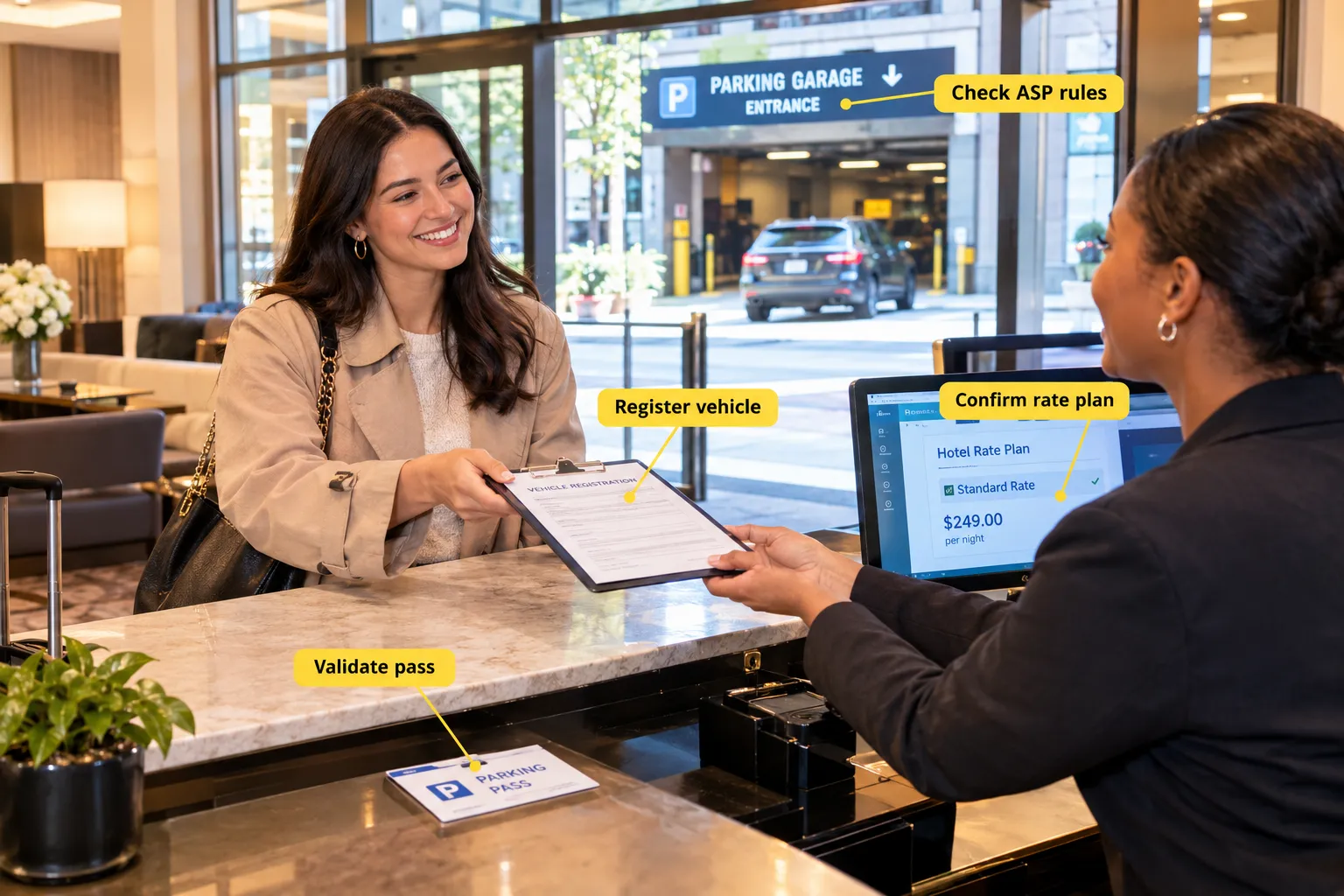
    Booking-platform listings lag behind real-time availability and policy changes. Call the hotel 48-72 hours before check-in to confirm:

    • Current availability of free parking spaces
    • Vehicle registration requirements at the front desk
    • Any recent changes to the free-parking policy
    • Whether your specific reservation rate qualifies for complimentary parking
    • Garage height clearances if driving an SUV or van

    Tripadvisor reviews from August 2026 repeatedly mention the need to «register the vehicle at the front desk» even when parking is free, indicating that hotels track which cars belong to guests to prevent unauthorized use of limited spaces.[1] Skipping this registration step can result in towing, even at properties advertising free parking.

    Step 5: Have a Backup Plan for Overflow

    When hotel parking fills, identify nearby alternatives in advance. Parking in Manhattan, NYC and Parking in Bronx, NYC directories list off-street garages and lots with published rates, many offering early-bird or overnight specials that undercut hotel valet fees. Apps like Best Parking Apps NYC 2026 aggregate real-time availability and pricing across hundreds of facilities.

    For extended stays, consider monthly parking at garages near the hotel. Facilities such as MPG Parking and Quik Park offer monthly contracts that can cost less per day than nightly hotel valet rates, even when the hotel advertises «free» parking with restrictive conditions.

    Common Restrictions on Free Hotel Parking in NYC

    «Free parking» rarely means unlimited, unrestricted access. Nearly every NYC hotel with complimentary parking imposes at least one of the following limitations.

    One Vehicle Per Room Maximum

    Both 1 Hotel Central Park and Westgate New York Grand Central cap free parking at one vehicle per room, regardless of room size or number of guests.[8][14] Families or groups traveling with multiple cars must pay standard rates for additional vehicles, which can exceed $60 per night at Manhattan properties.

    No In-Out Privileges

    Westgate’s free-parking terms explicitly state that removing a vehicle and returning triggers additional fees, effectively locking the car in the garage for the duration of the stay.[14] This restriction makes free parking impractical for travelers planning day trips outside the city or needing vehicle access for business appointments.

    Vehicle Size and Type Restrictions

    Westgate charges an extra $25 per day for oversized vehicles under its free-parking rate, defining standard eligibility as cars and SUVs only.[14] Vans, trucks, and vehicles with roof racks or modifications may not qualify for complimentary parking even when the base rate includes it.

    Rate-Plan and Blackout Date Dependencies

    Promotional free-parking offers tie the benefit to specific booking codes and exclude peak travel dates. 1 Hotel Central Park’s offer lists blackout dates and requires booking the «Free to Park, Free to Explore» rate directly, third-party reservations and standard rates do not include the parking benefit.[8] Always confirm that your exact reservation qualifies rather than assuming the hotel’s advertised free parking applies universally.

    First-Come-First-Served Availability

    Hotels with limited parking cannot guarantee space even for confirmed reservations. Hampton Inn New York, LaGuardia Airport and Hotel Le Bleu both operate on a first-come-first-served basis, meaning late arrivals may find the lot full and need to seek overflow parking at their own expense.[12] This risk is highest on weekends and during major NYC events when hotel occupancy peaks.

    Regional Pricing and Availability Patterns

    Location dramatically impacts both the likelihood of finding free parking and the overall room rate. Hotels with free parking cluster in predictable geographic patterns across New York City.

    Manhattan: Rare and Promotional

    Truly free parking in Manhattan remains scarce outside time-limited promotions. KAYAK data from November 2025 reported an average of $118 per night for Manhattan hotels with free parking, though sample inconsistencies suggest this figure may blend non-NYC locations.[10] Current August 2026 data shows Manhattan properties with free parking averaging significantly higher, closer to the citywide $443 mean.[5]

    Expect Manhattan free-parking offers to come with the most restrictive terms: valet-only, one vehicle, no in-out, and promotional rate dependencies. The few properties offering it year-round typically sit north of 125th Street or along the far west side near the Hudson River.

    Outer Boroughs: More Common, Lower Rates

    Brooklyn, Queens, the Bronx, and Staten Island hotels more frequently include free parking as a standard amenity. Hotels.com’s August 2026 listings identify multiple properties in these boroughs where parking is complimentary across all rate plans.[11] Room rates in outer-borough hotels with free parking average $150,$250 per night, roughly half the Manhattan equivalent.

    Travelers staying in Parking in Astoria, Queens or Parking in Flushing, Queens neighborhoods benefit from both free hotel parking and easier street parking when exploring the local area, though commutes to Midtown Manhattan require 30-45 minutes on the subway.

    Airport Hotels: Consistent Availability

    Properties near LaGuardia, JFK, and Newark airports maintain the most reliable free-parking inventory. These hotels cater to fly-in guests who need secure vehicle storage during trips, making complimentary parking a competitive necessity. Rates typically range $100,$180 per night, with parking included in the base price rather than as an add-on.[12][13]

    Airport-area hotels also commonly offer free shuttle service to terminals, making them practical for travelers who want to avoid long-term airport parking fees ($40,$50 per day at JFK and LaGuardia) while maintaining vehicle access before and after flights.

    Alternatives When Hotel Free Parking Is Unavailable

    When preferred hotels lack free parking or spaces fill up, several cost-effective alternatives exist for drivers staying in NYC.

    Monthly Garage Contracts

    For stays exceeding one week, monthly parking contracts at nearby garages often cost less per day than nightly hotel rates. Facilities in Parking in Manhattan, NYC and Parking in Bronx, NYC offer monthly rates starting around $300,$400, equivalent to $10,$13 per day for a 30-day period. This approach works best when the hotel sits within walking distance of the garage.

    Early-Bird and Overnight Specials

    Many commercial garages offer discounted overnight rates for cars entering after 6 PM and exiting before 10 AM, with prices as low as $15,$25 per night in outer-borough locations. Check Parking Garages & Savings for current promotions and compare rates across multiple facilities near the hotel.

    Strategic Street Parking with ASP Monitoring

    Experienced NYC drivers can use free street parking legally by monitoring Alternate Side Parking suspension calendars and moving vehicles only when enforcement is active. This strategy requires daily attention to ASP status and willingness to relocate the car 1-2 times per week, but eliminates parking costs entirely in neighborhoods with available curb space.

    Download a real-time ASP tracker to receive alerts before street-cleaning enforcement begins. Missing an ASP move can result in a $65 ticket plus potential towing, quickly erasing any savings from avoiding hotel parking fees. Understand how to fight unfair parking citations if disputes arise.

    Park Outside NYC and Use Transit

    For travelers whose itineraries center on Manhattan attractions rather than outer-borough driving, parking in Yonkers, New Rochelle, or other nearby municipalities and commuting via Metro-North or subway can reduce costs. Check Yonkers Alternate Side Parking and New Rochelle Alternate Side Parking for local street rules, then use commuter rail to reach Midtown in 30-40 minutes.

    This approach works best for multi-day stays where the vehicle remains parked continuously. Daily round-trip Metro-North fares ($15,$20) plus free street parking in Westchester often total less than a single night of Manhattan hotel parking.

    Conclusion

    Finding a hotel with free parking NYC in 2026 requires filtering booking platforms carefully, reading rate-plan fine print, and confirming details directly with properties before arrival. While roughly 279 hotels across the five boroughs advertise some form of complimentary parking, nearly all impose restrictions on vehicle count, size, in-out privileges, or rate eligibility.[5] Budget and airport hotels in outer boroughs offer the most consistent free-parking availability, while Manhattan properties reserve the perk for promotional offers with blackout dates and strict terms.[8][14]

    Take these steps now: Use KAYAK or Expedia’s free-parking filters to identify candidate hotels, book at least 87 days in advance to secure the lowest rates, and call the hotel 48 hours before check-in to verify space availability and registration requirements.[5] Set up real-time Alternate Side Parking alerts if relying on street parking at any point, and bookmark nearby garage directories as backup options. With proper planning and direct confirmation, travelers can eliminate $300,$600 in parking costs over a week-long NYC stay while avoiding the stress of meter feeding and ASP violations.

    References

    [1] Hotels G60763 Zfa7 New York City New York Hotels – https://www.tripadvisor.com/Hotels-g60763-zfa7-New_York_City_New_York-Hotels.html

    [3] Hotels G28953 Zfa7 New York Hotels – https://www.tripadvisor.com/Hotels-g28953-zfa7-New_York-Hotels.html

    [5] New York Hotels Free Parking.hfp.15830.hotel – https://www.kayak.com/New-York-Hotels_Free-Parking.Hfp.15830.hotel.ksp

    [7] New York Hotels Hotels With Free Parking.0 0 D178293 Thotelswithfreeparking.travel Guide Filter Hotels – https://www.expedia.com/New-York-Hotels-Hotels-With-Free-Parking.0-0-d178293-tHotelswithFreeParking.Travel-Guide-Filter-Hotels

    [8] Free Park Free Explore – https://www.1hotels.com/central-park/offers/free-park-free-explore

    [10] Manhattan Hotels Free Parking.hfp.10162.hotel – https://www.kayak.com/Manhattan-Hotels_Free-Parking.Hfp.10162.hotel.ksp

    [11] New York Hotels Hotels With Free Parking.0 0 D178293 Thotelswithfreeparking.travel Guide Filter Hotels – https://www.expedia.com/New-York-Hotels-Hotels-With-Free-Parking.0-0-d178293-tHotelswithFreeParking.Travel-Guide-Filter-Hotels

    [12] Hotels G28953 Zfa7 New York Hotels – https://www.tripadvisor.com/Hotels-g28953-zfa7-New_York-Hotels.html

    [13] New York Hotels Hotels With Free Parking.0 0 D178293 Thotelswithfreeparking.travel Guide Filter Hotels – https://www.expedia.com/New-York-Hotels-Hotels-With-Free-Parking.0-0-d178293-tHotelswithFreeParking.Travel-Guide-Filter-Hotels

    [14] Free Park Free Explore – https://www.1hotels.com/central-park/offers/free-park-free-explore

  • What Time Do They Boot Cars in NYC: Official 2026 Enforcement Guide

    What Time Do They Boot Cars in NYC: Official 2026 Enforcement Guide

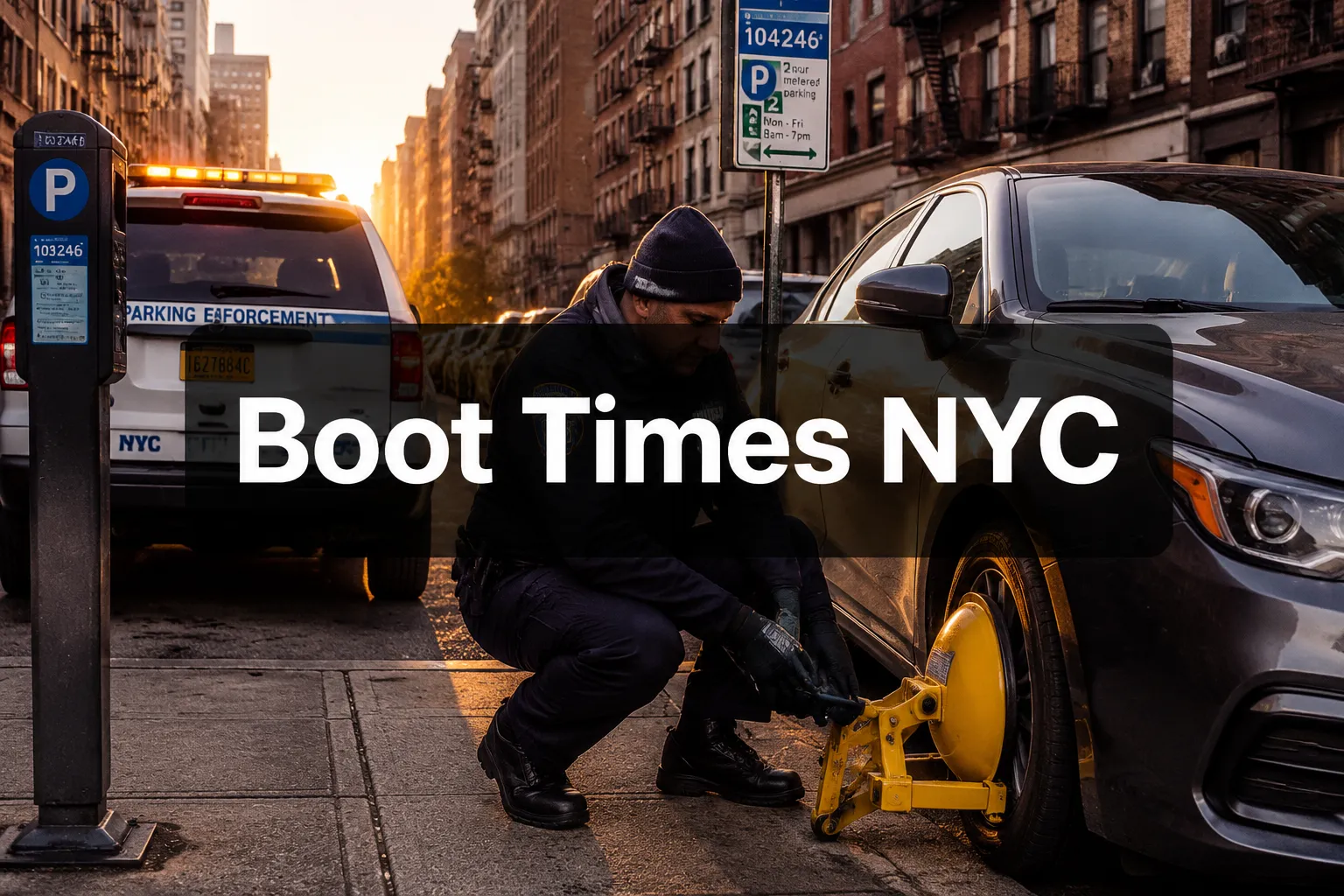
    New York City boots approximately 135,000 vehicles every year, yet there’s no single «boot time» marked on any enforcement schedule. Understanding what time do they boot cars in NYC requires knowing how parking violations, judgment debt, and enforcement patterns intersect across all five boroughs in 2026.

    The short answer: NYC does not boot cars at a specific time of day. Enforcement officers identify eligible vehicles throughout their shifts, typically between 7 AM and 7 PM on weekdays, though boots can be placed anytime a marshal or authorized contractor locates a scofflaw vehicle. Your car becomes eligible for booting the moment your unpaid parking tickets and camera violations reach $350 or more in judgment debt [1].

    This guide provides real-time clarity on boot enforcement schedules, payment procedures, and how to avoid fines and towing across New York City.

    Key Takeaways

    • NYC boots vehicles with $350+ in judgment debt, not at fixed daily times, enforcement runs primarily 7 AM, 7 PM weekdays [1]
    • Republic Immobilization Services administers the boot program; once booted, you have 48 hours to pay before towing risk [3]
    • Payment and boot authorization are available 24/7 online and by phone; removal at drop-off sites operates around the clock at many locations [1]
    • In-person DOF Business Centers operate weekdays 8:30 AM, 4:30 PM for payment of boot and tow debt [7]
    • Check your vehicle’s violation status and Alternate Side Parking rules daily to stay ahead of judgment debt

    Understanding NYC’s Boot Program: No Fixed «Boot Time»

    Many drivers assume parking enforcement operates on a predictable clock. In reality, what time do they boot cars in NYC depends entirely on when enforcement officers encounter your vehicle during their patrol routes [1].

    The NYC Department of Finance contracts with Republic Immobilization Services to identify and immobilize vehicles with outstanding judgment debt. Enforcement personnel work standard business hours,typically 7 AM to 7 PM Monday through Friday,but boots can legally be placed anytime an authorized agent locates an eligible vehicle, including weekends and evenings [3].

    The $350 Judgment Debt Threshold

    Your vehicle becomes boot-eligible when:

    • Total unpaid parking tickets, camera violations, and related fees reach $350 or more in judgment debt [1]
    • Violations have entered judgment status (you missed the dispute window and payment deadline)
    • Your license plate is flagged in the city’s scofflaw database

    Judgment debt accumulates faster than many drivers realize. A single street-cleaning ticket ($65) combined with a few expired-meter violations can push you over the threshold within weeks if left unpaid.

    Peak Enforcement Windows

    While no official «boot time» exists, enforcement activity clusters during:

    • Morning hours (7 AM, 11 AM): Officers patrol Alternate Side Parking zones during street cleaning windows
    • Midday (11 AM, 3 PM): Residential and commercial district sweeps
    • Late afternoon (3 PM, 7 PM): Final patrol rounds before shift end

    Enforcement is lighter on weekends and holidays, but scofflaw vehicles remain eligible 24/7/365.

    Peak Enforcement Windows

    What Happens After Your Car Gets Booted in NYC

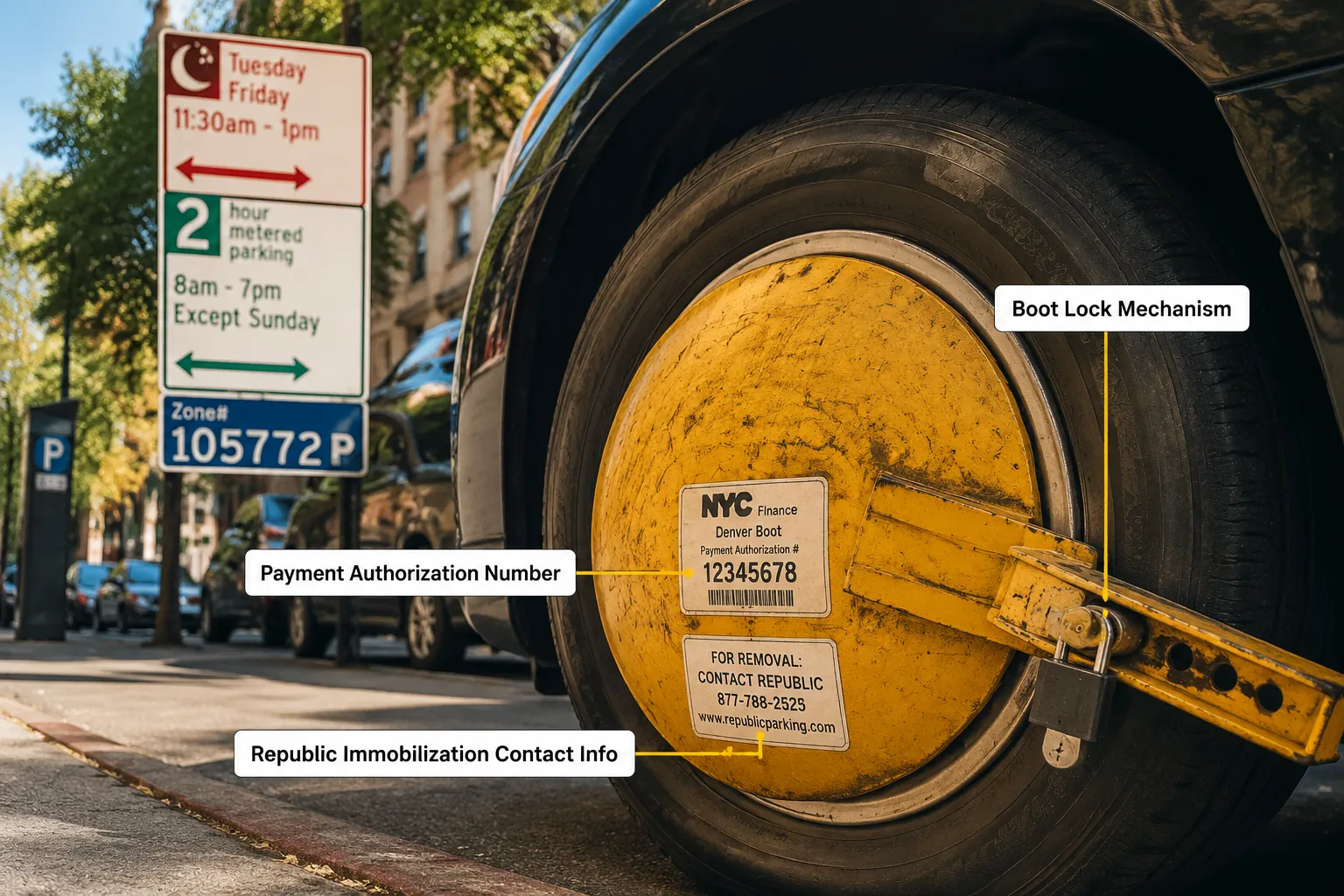
    Once a boot is installed, a bright yellow immobilization device locks onto your wheel, and a violation notice is affixed to your windshield [3]. The notice displays:

    • Your total judgment debt amount
    • Payment authorization phone number (646-517-1000)
    • Boot identification number
    • Warning: 48 hours to pay before towing [2]

    The 48-Hour Towing Window

    This is critical: you have 48 hours from the moment of booting to pay your debt and arrange boot removal [2]. After 48 hours, the city may tow your vehicle to an impound lot, adding:

    • Towing fees ($185+)
    • Daily storage charges ($20/day)
    • Additional administrative costs

    If your vehicle remains unclaimed for 10 days after towing, it becomes eligible for public auction [6].

    For help locating a towed vehicle, consult our comprehensive guide on how to find your towed car in NYC.

    24/7 Payment and Authorization

    Unlike many city services, boot payment and removal authorization operate around the clock [1]:

    Online Payment (24/7): Visit the NYC DOF website, enter your license plate, pay the full judgment debt plus boot fee ($136 as of 2026) [1]

    Phone Payment (24/7): Call 646-517-1000 to pay by credit/debit card and receive an authorization number immediately [1]

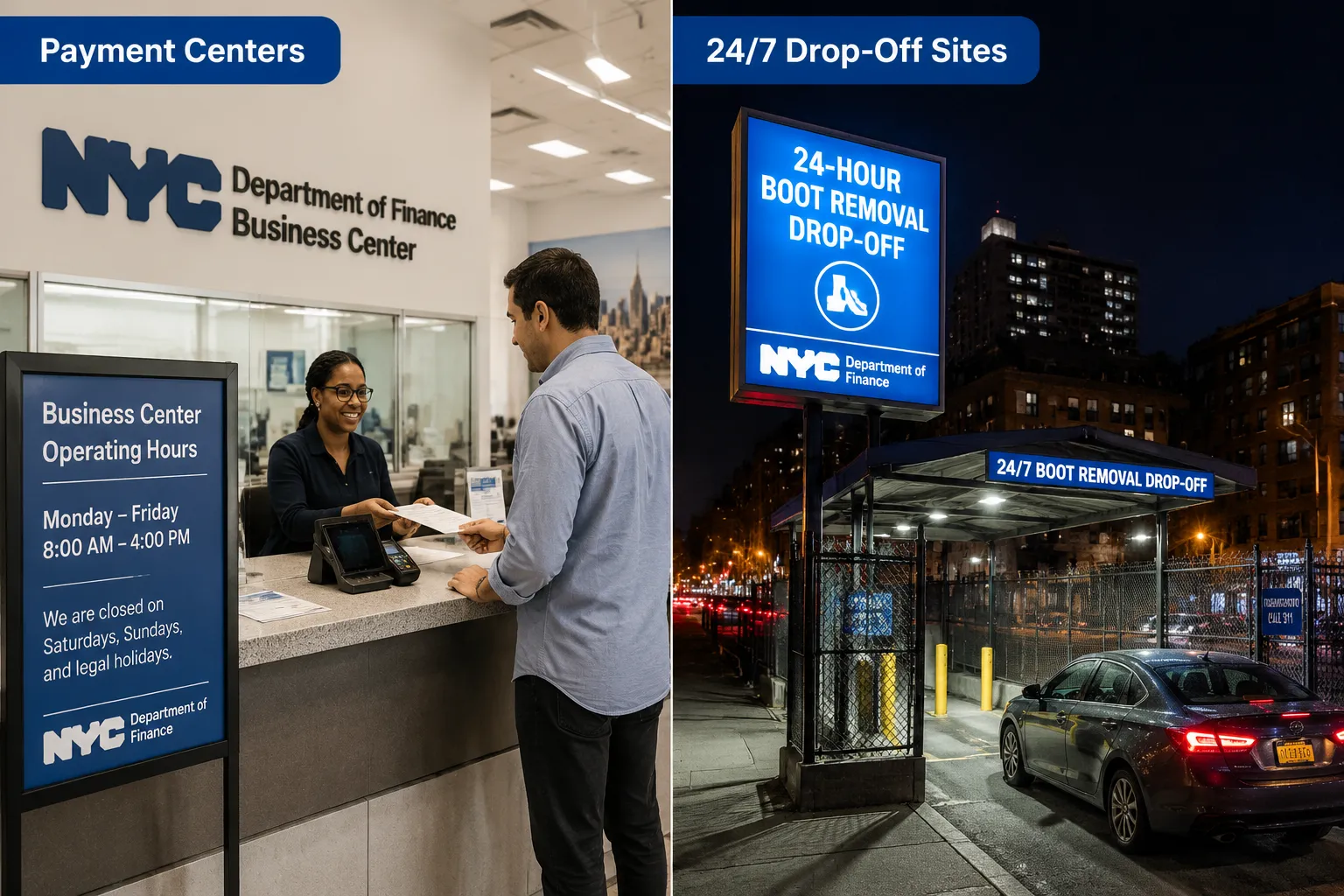
    In-Person Payment (Weekdays 8:30 AM, 4:30 PM): Visit any NYC Department of Finance Business Center to pay in person [7]

    Once payment clears, you receive a release authorization number. You must then drive (carefully, with the boot still attached) to an authorized drop-off location to have the boot physically removed.

    Boot Removal Drop-Off Locations and Hours

    After receiving your authorization number, you must visit a Republic Immobilization Services drop-off site to have the boot removed [3].

    Drop-Off Site Operating Hours

    24-Hour Locations (most common): Many drop-off sites operate continuously, allowing immediate removal any time of day or night [1]

    Limited-Hour Locations: Some sites maintain business-hour schedules (typically 8 AM, 6 PM weekdays) [3]

    Critical: Verify your nearest drop-off location’s hours before driving there. The authorization number you receive will include the closest site address and contact information.

    Removal Process

    1. Drive slowly to the drop-off location (the boot allows limited movement)
    2. Present your authorization number to the attendant
    3. Wait while the technician removes the boot (typically 5-15 minutes)
    4. Inspect your wheel for any damage before leaving

    Do not attempt to remove the boot yourself. Tampering with or damaging a boot is a criminal offense and will result in additional fines and potential arrest [2].

    Removal Process

    How to Avoid Getting Booted: Proactive Strategies

    Prevention is always cheaper than cure. Follow these strategies to stay off the boot list:

    Monitor Your Violation Status Weekly

    Check your parking ticket balance every week at the NYC DOF website. Set a calendar reminder. Judgment debt accumulates silently, by the time you notice, you may already be boot-eligible.

    Pay or Dispute Tickets Immediately

    You have 30 days to pay or dispute a parking ticket before it enters judgment [2]. Once in judgment, penalties increase and boot eligibility begins.

    For guidance on challenging unfair citations, visit our Tickets & Disputes resource hub.

    Use Real-Time Alternate Side Parking Alerts

    Street-cleaning violations are the most common path to boot eligibility. Stay informed with live ASP status:

    Consider Off-Street Parking for High-Risk Periods

    If you’re close to the $350 threshold and need time to resolve tickets, use secure off-street parking temporarily. Explore NYC Parking Directory for garage options across all boroughs.

    Understand No Standing Rules

    Many drivers confuse «No Parking» with «No Standing.» Learn the critical differences in our guide: What Does No Standing Mean in NYC?

    Boot vs. Tow: Understanding the Enforcement Escalation

    Booting is the first stage of NYC’s scofflaw enforcement ladder [6]:

    Stage 1: Boot Vehicle immobilized in place; 48-hour payment window; $136 boot fee

    Stage 2: Tow After 48 hours, vehicle towed to impound; $185+ towing fee plus $20/day storage

    Stage 3: Auction After 10 days unclaimed, vehicle sold at public auction; all debt transferred to owner’s record

    The city’s goal is revenue collection, not vehicle seizure. Pay within 48 hours and you’ll avoid the tow-and-storage cascade that can triple your total cost [6].

    For more on the towing process, see our Towing & Impounds articles.

    Frequently Asked Questions

    Can they boot my car on a Sunday? Yes. While enforcement is less common on weekends, boots can legally be placed any day if your vehicle is identified as a scofflaw [1].

    What if I’m in the car when they try to boot it? If you’re present and the boot is not yet installed, you may be able to drive away. Once the boot is locked, you cannot leave and must follow the payment process [2].

    Can I get booted for one unpaid ticket? No. You need $350 or more in judgment debt to become boot-eligible [1]. A single ticket will not trigger booting.

    How long does boot removal take after I pay? Online and phone payments post immediately, and you receive an authorization number within minutes. Physical removal at a drop-off site takes 5-15 minutes [1].

    What if I can’t afford to pay the full amount? NYC offers payment plans for judgment debt. Contact the Department of Finance at 646-517-1000 to discuss installment options. However, the boot will not be removed until full payment is made [9].

    Do boots damage my car? Properly installed boots should not damage your vehicle. If you notice wheel or tire damage after removal, document it immediately and file a claim with the Department of Finance [2].

    Conclusion

    What time do they boot cars in NYC? The answer is: anytime your vehicle is found with $350+ in judgment debt, though enforcement is most active 7 AM, 7 PM on weekdays. There is no fixed «boot time», only eligibility thresholds and patrol patterns.

    Take action now:

    1. Check your violation status at the NYC DOF website today
    2. Pay or dispute any outstanding tickets within 30 days
    3. Set up Alternate Side Parking alerts to avoid street-cleaning violations
    4. Bookmark payment and removal resources so you’re prepared if booted
    5. Explore off-street parking options if you’re close to the $350 threshold

    Stay ahead of judgment debt, monitor suspension calendars, and use real-time ASP status tools to avoid fines and towing. For more parking guidance, visit the Park Rules Live Blog and explore our New York City Articles for neighborhood-specific tips.

    References

    [1] Services Booting – https://www.nyc.gov/site/finance/vehicles/services-booting.page [2] Article – https://portal.311.nyc.gov/article/?kanumber=KA-02054 [3] Vehicle Booting – https://www.risnyc.com/vehicle-booting/ [6] Nyc Boot Tow Guide – https://clearplates.com/insights/nyc-boot-tow-guide [7] Contact Us By Visit – https://www.nyc.gov/site/finance/about/contact-us-by-visit.page [9] Contact Us – https://www.nyc.gov/site/finance/about/contact-us.page

  • How to Fight a Parking Ticket in NYC: Official 2026 Dispute Guide

    How to Fight a Parking Ticket in NYC: Official 2026 Dispute Guide

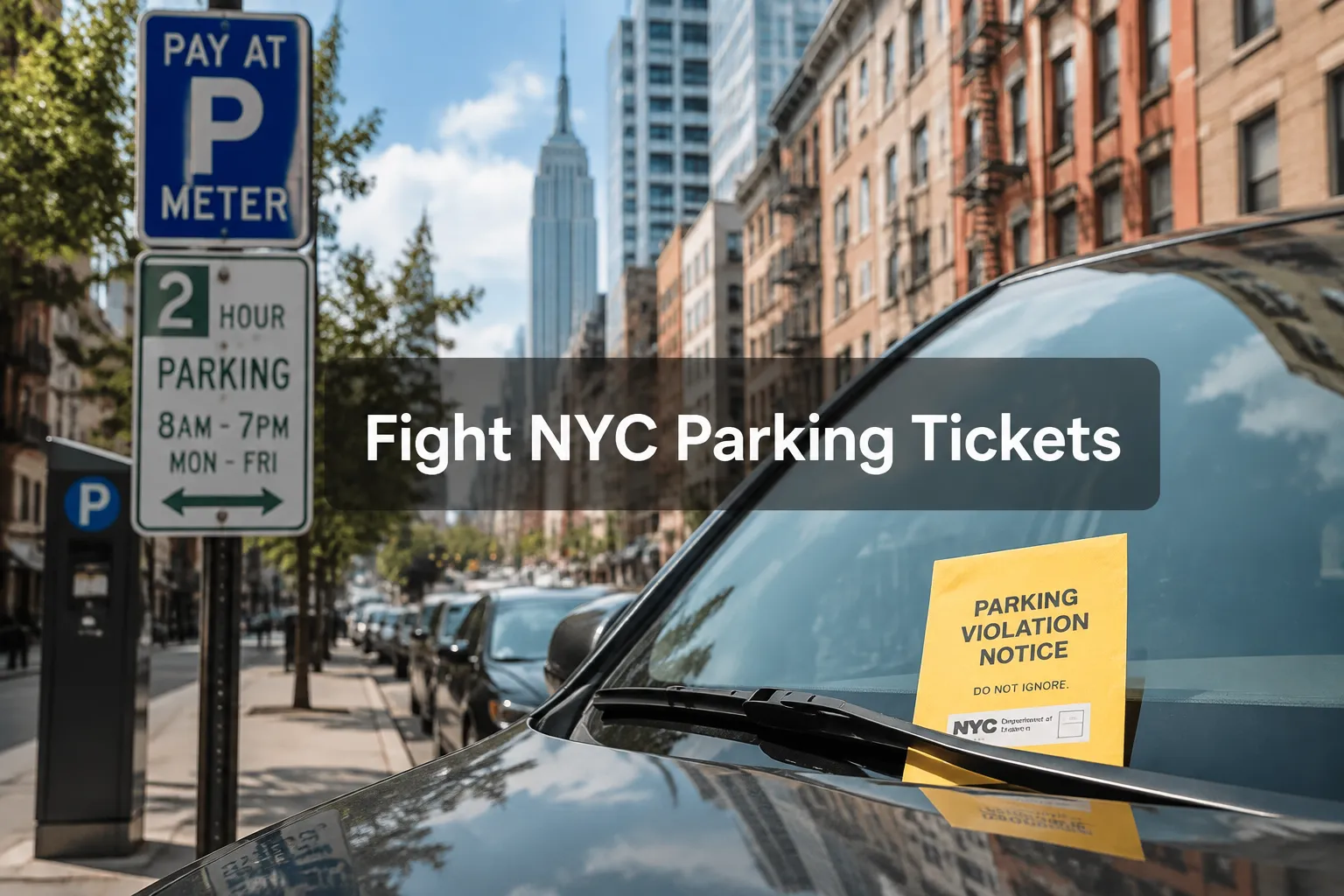
    New York City issued over 10 million parking tickets in 2025, generating more than $500 million in revenue. Yet thousands of those citations contained errors, unclear signage, or impossible-to-comply restrictions. If you received an unfair parking citation, you have exactly 30 days to challenge it before penalties double and your options narrow. Understanding how to fight a parking ticket in NYC through the official dispute process can save hundreds of dollars and protect your driving record from unjust violations.

    Key Takeaways

    • Request a hearing within 30 days of the ticket date to avoid late penalties and preserve all dispute rights
    • Use the NYC Department of Finance online portal, Pay or Dispute app, mail, or in-person hearing for fastest resolution
    • Gather time-stamped photos of signs, meters, street conditions, and vehicle registration as primary evidence
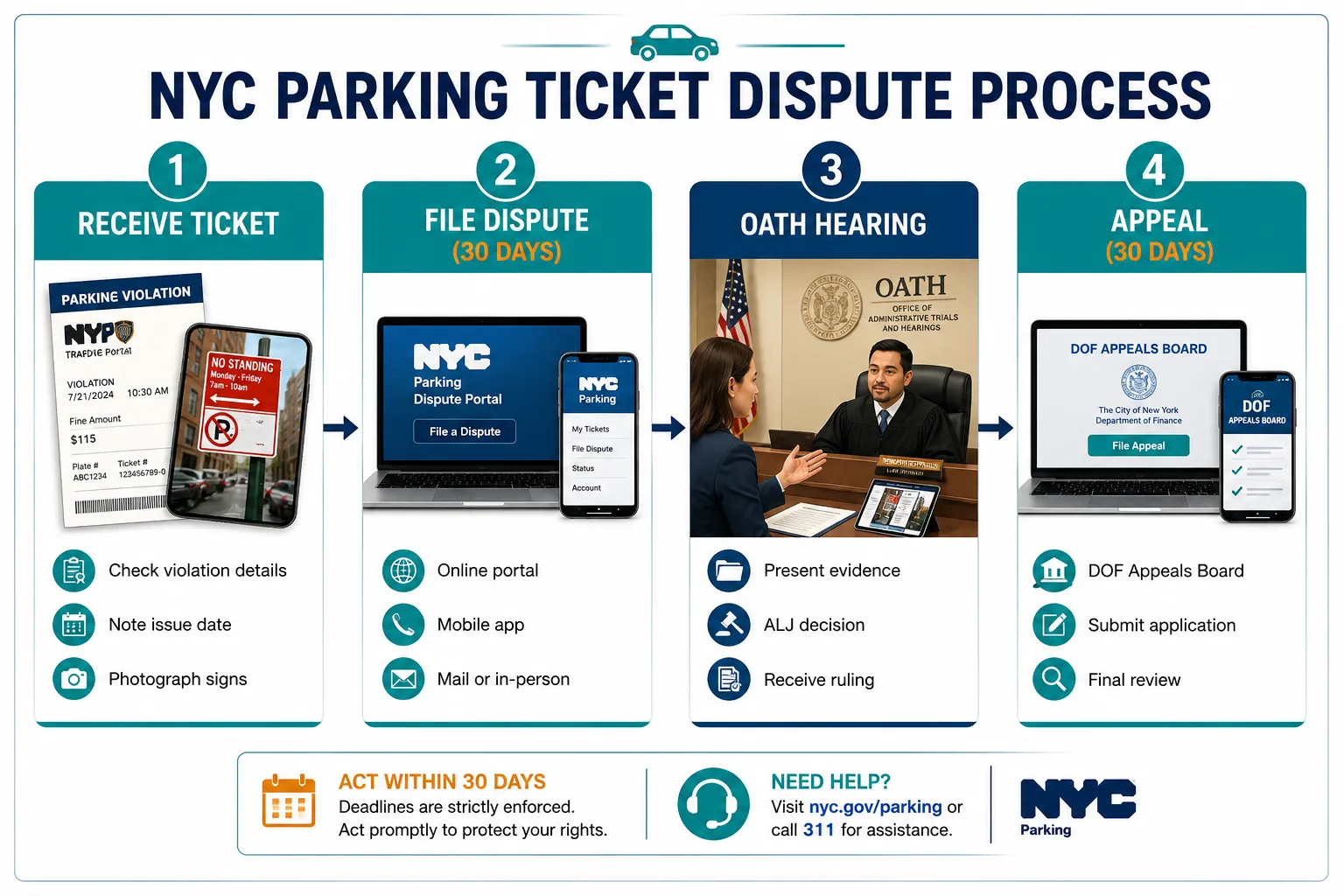
    • OATH Administrative Law Judges hear all parking ticket disputes; appeal unfavorable decisions to the DOF Appeals Board within 30 days
    • Document sign errors, conflicting regulations, meter malfunctions, and impossibility of compliance as strongest defenses

    Understanding NYC Parking Ticket Dispute Deadlines

    Understanding NYC Parking Ticket Dispute Deadlines

    The 30-day deadline controls everything in NYC parking ticket disputes. From the violation date (or notice of liability date if you weren’t present), you have exactly 30 calendar days to request a hearing with the Department of Finance.[6][8] Missing this window triggers automatic late penalties, typically doubling the fine, and eliminates your ability to present a defense.

    Critical Timeline Structure:

    • Days 1-30: File dispute online, via Pay or Dispute app, by mail, or in-person at any DOF Finance Business Center
    • Hearing phase: OATH schedules and conducts your hearing (timing varies by method and volume)
    • Decision issued: Administrative Law Judge rules guilty or not guilty
    • Days 1-30 post-decision: File appeal with DOF Appeals Board if found guilty[1][4]

    The Department of Finance explicitly warns against disputing tickets online if you believe they’ve already been paid or dismissed, verify status first through the official portal.[8][12] For moving violations handled by the Traffic Violations Bureau (TVB), a separate 30-day appeal process applies using form AA-33 and a $10 fee, but those are distinct from parking citations.[3]

    Check the real-time Alternate Side Parking status to confirm whether street cleaning was actually in effect on your violation date, suspension calendars often provide immediate grounds for dismissal.

    How to Fight a Parking Ticket in NYC: Four Official Methods

    The NYC Department of Finance offers four distinct channels to dispute parking tickets, each with specific advantages for different situations.[6][13]

    Online Dispute Portal (Fastest)

    Access the official DOF dispute system at nyc.gov/finance. Enter your violation number, license plate, and state. The portal, updated August 25, 2026, walks you through submitting your defense statement and uploading supporting evidence, photos, registration copies, maps, and witness statements.[8] This method provides the fastest processing and automatic confirmation of submission.

    Pay or Dispute Mobile App

    Download the official NYC Pay or Dispute app for iOS or Android. Scan or enter your ticket details, photograph evidence directly from your phone, and submit your dispute in under five minutes. The app integrates with the same OATH hearing system as the web portal and sends status notifications.[6]

    Mail Submission

    Complete the dispute form on the back of your parking ticket or download the official form from nyc.gov/finance. Include a detailed written statement explaining why the ticket is invalid, attach copies (never originals) of supporting documents, and mail to the address printed on your ticket. Allow extra time for processing, mail disputes take longer than digital submissions.[6]

    In-Person Hearings

    Walk into any DOF Finance Business Center Monday, Friday, 8:30 a.m. to 4:30 p.m., without an appointment. In-person hearings operate first-come, first-served. Bring your ticket, valid driver’s license, vehicle registration, title or rental agreement, and all evidence.[11][13] You may bring an eligible representative to speak on your behalf. In-person hearings offer immediate interaction with an Administrative Law Judge and real-time clarification of questions.

    Locate convenient off-street parking near Finance Business Centers to avoid additional violations while attending your hearing.

    Building a Winning Defense: Evidence and Documentation

    Building a Winning Defense: Evidence and Documentation

    Administrative Law Judges at OATH evaluate parking ticket disputes based on photographic evidence, official records, and witness testimony. Strong defenses focus on four categories of error.[2][5][9][10]

    Ticket Errors and Inaccuracies

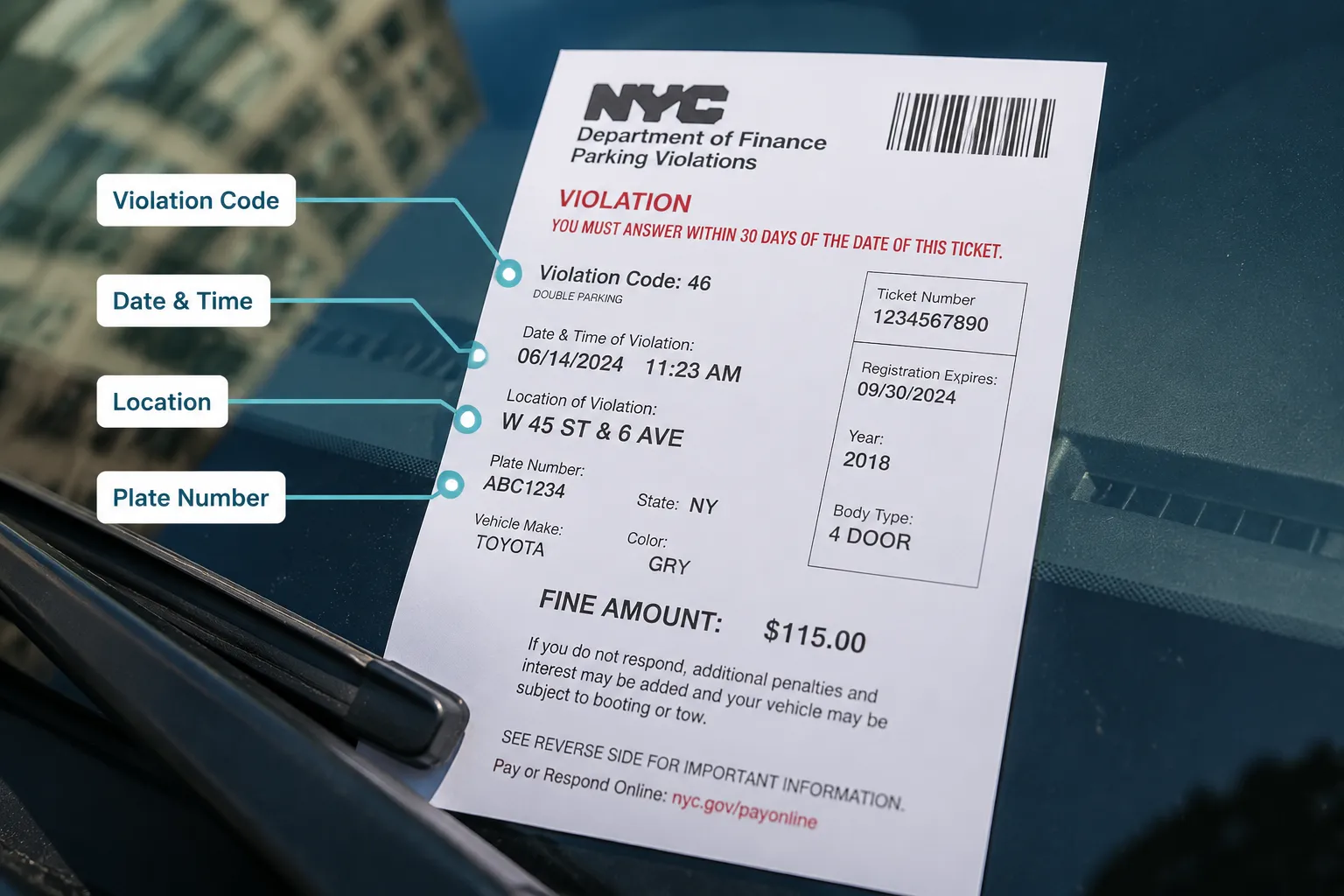
    Examine every field on your citation:

    • License plate number: Wrong plate, incorrect state, transposed digits
    • Vehicle description: Wrong make, model, color, or body type
    • Location: Incorrect street name, block number, or cross street
    • Date and time: Violation recorded on wrong date or impossible time
    • Violation code: Citation references inapplicable regulation

    Even minor clerical errors can invalidate a ticket if they prevent proper identification of the vehicle or violation.[7][9]

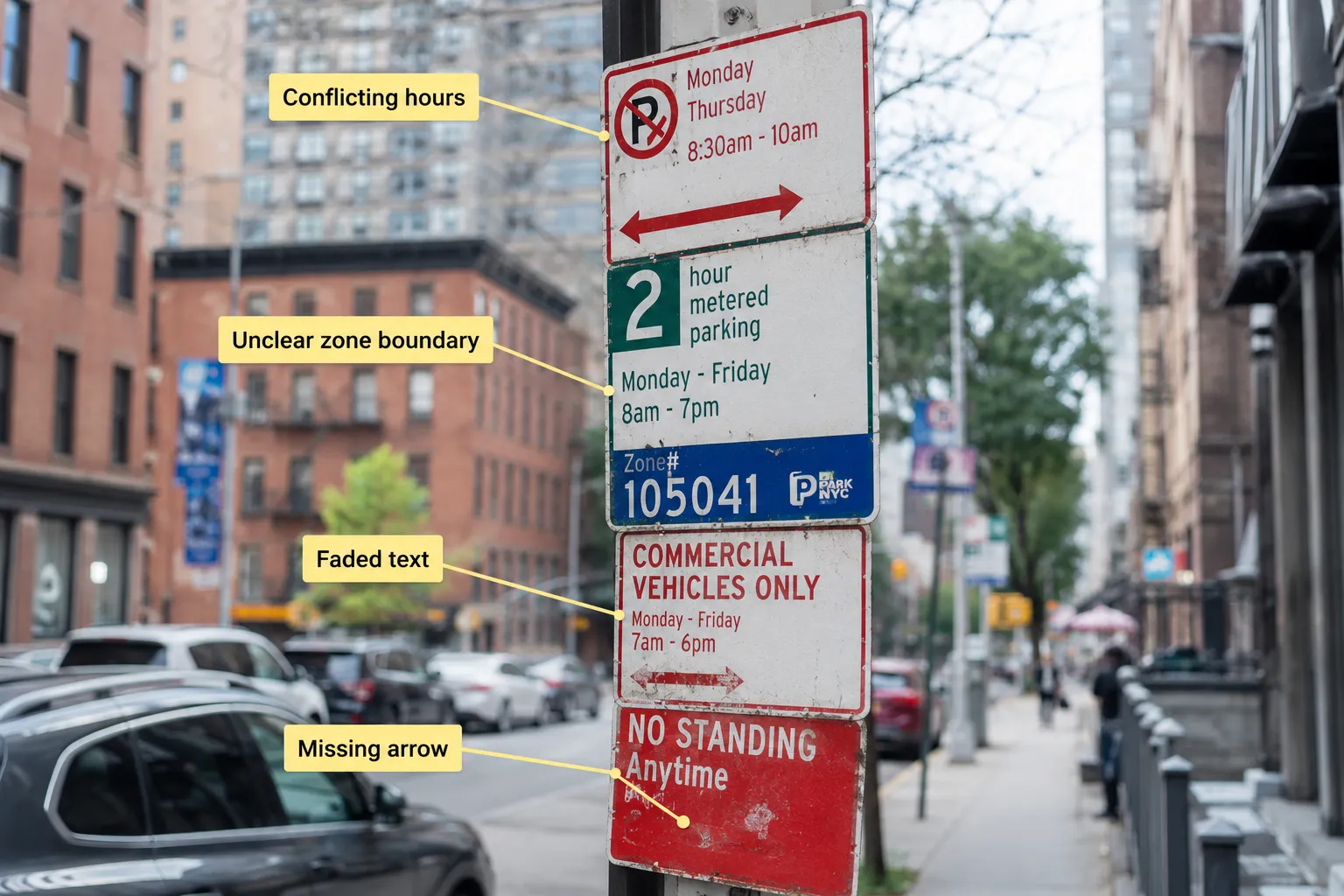
    Signage Defects and Confusion

    Photograph the exact location where your vehicle was parked, capturing:

    • Missing signs: No posted restriction where citation claims one exists
    • Obscured signs: Trees, graffiti, damage, or fading rendering text unreadable
    • Conflicting regulations: Overlapping meter hours, street cleaning times, and commercial restrictions creating impossible-to-follow rules
    • Incorrect placement: Signs positioned beyond legal visibility distance or facing wrong direction

    Include wide-angle shots showing the full block context and close-ups of specific sign text. Time-stamp all photos and note the exact address.[2][5][10]

    Meter Malfunctions and Payment Proof

    If cited for expired meter or failure to pay:

    • Receipt or app confirmation: ParkNYC, ParkMobile, or meter receipt showing valid payment covering the violation time
    • Meter malfunction: Photos of broken meter display, card reader errors, or «out of service» status
    • Payment system failure: Bank statement proving attempted payment that didn’t register

    The best parking apps in NYC provide timestamped digital receipts that serve as primary evidence in meter disputes.

    Impossibility and Necessity Defenses

    Document circumstances that made compliance impossible:

    • Medical emergency: Hospital records, ambulance reports, or physician statements
    • Vehicle breakdown: Tow truck receipts, mechanic invoices, or roadside assistance logs
    • Street cleaning suspension: Official suspension calendar showing ASP was not in effect on violation date
    • Authorized parking: Placard, permit, or official authorization for the location and time

    Alternate Side Parking suspensions are particularly common grounds for dismissal. Verify the official status for your violation date through NYC ASP suspension calendars before submitting your defense.

    The OATH Hearing Process and What to Expect

    The Office of Administrative Trials and Hearings (OATH) conducts all NYC parking ticket hearings, even though the Department of Finance manages the financial and portal systems.[6][7][15] Understanding this separation clarifies the adjudication process.

    When you dispute a ticket through any of the four methods, your case transfers to OATH for review. An Administrative Law Judge (ALJ) examines your written defense and evidence for online/mail disputes, or conducts a live hearing for in-person submissions.[7][15]

    Online and Mail Hearings:

    The ALJ reviews your submitted statement, photographs, documents, and any response from the issuing agency. No live appearance required. The judge issues a written decision based solely on the evidence in the record. Processing time varies from weeks to months depending on case volume.

    In-Person Hearings:

    Present your case directly to the ALJ at a Finance Business Center. Explain why the ticket is invalid, present physical evidence, and answer the judge’s questions. The hearing typically lasts 10-20 minutes. The ALJ may issue an immediate oral decision or mail a written ruling within days.[11][13]

    Prepare a clear, chronological narrative: «On [date], I parked at [location] at [time]. The posted signs showed [description]. I paid the meter through [method] as shown in [receipt]. The ticket claims [violation], but [your evidence] proves this is incorrect.»

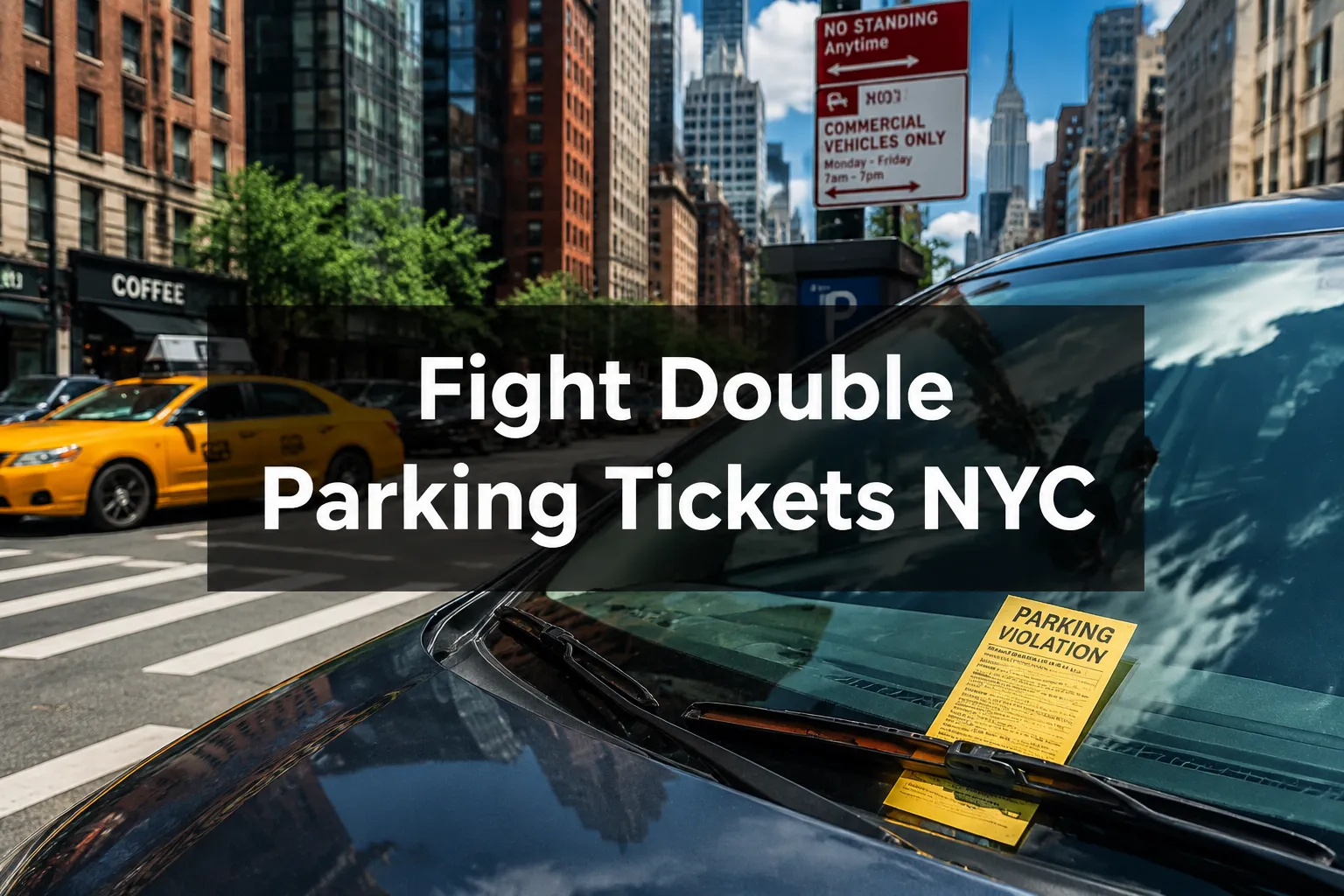
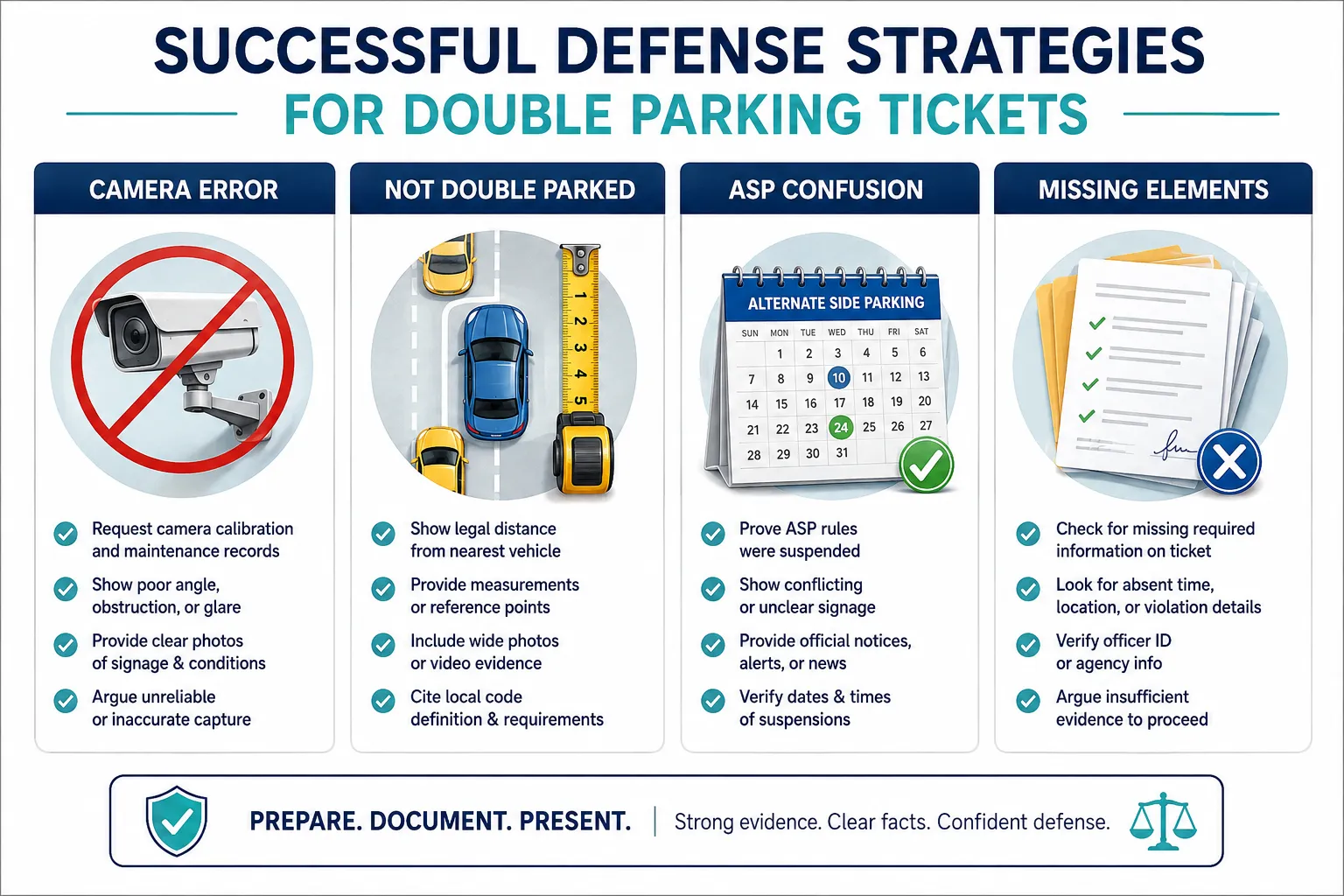
    For double parking ticket disputes, specific defenses apply based on loading zone access, commercial vehicle status, and duration of stop.

    How to Appeal a Parking Ticket Decision in NYC

    If the OATH Administrative Law Judge finds you guilty, you have 30 calendar days from the hearing decision date to file a Parking/Camera Violations Appeal Application with the DOF Appeals Board.[1][4] This internal appeal is your second opportunity to challenge the citation before moving to court.

    DOF Appeals Board Process

    Download the official appeal form from nyc.gov/finance or request one by mail. The application requires:

    • Original ticket information: Violation number, plate, date, location
    • Hearing decision details: Date of decision, ALJ name, case number
    • Grounds for appeal: Specific legal or factual errors in the ALJ’s ruling
    • Supporting evidence: New evidence not available at the original hearing, or demonstration that existing evidence was misinterpreted

    Mail the completed application to the address on the form. The Appeals Board reviews the case record, your appeal statement, and any agency response. The Board can affirm the guilty finding, reverse it to not guilty, or remand the case for a new hearing.[1][5]

    You must pay the fine before filing an appeal, but the amount will be refunded if your appeal succeeds.[5][10] The Appeals Board typically issues decisions within 60-90 days of submission.

    Judicial Review: Article 78 and Civil Court

    If the DOF Appeals Board denies your appeal, two judicial options remain:

    Article 78 Proceeding (Supreme Court):

    File a petition in New York State Supreme Court (typically 60 Centre Street, Room 116, Manhattan) within four months of the final agency determination. Article 78 review challenges whether the agency acted arbitrarily, capriciously, or contrary to law. This is a legal proceeding requiring formal court filings and often benefits from attorney representation.[4][7]

    NYC Civil Court Review:

    After an OATH decision, you may also seek review in NYC Civil Court. This option provides an alternative judicial forum for challenging the administrative ruling.[7]

    Both judicial reviews focus on legal errors rather than re-examining factual evidence. Courts defer to agency fact-finding unless the record shows no rational basis for the decision.

    Requesting a Hearing Transcript

    For in-person hearings, request an official transcript of the proceeding to support your appeal. DOF will inform you of the transcript cost within seven business days. Pay by check within 10 business days if you decide to proceed. Transcripts provide the verbatim record needed to identify legal errors or misstatements in the ALJ’s ruling.[6]

    Common Defenses That Win NYC Parking Ticket Disputes

    Certain defenses consistently succeed before OATH Administrative Law Judges based on 2026 case patterns and expert guidance.[2][5][9][10]

    Sign Visibility and Clarity:

    Regulations require parking restriction signs to be clearly visible from the driver’s position. Photos showing obstructed, damaged, or missing signs frequently result in dismissals. Include measurements of sign placement and angles demonstrating poor visibility.

    Conflicting Regulations:

    When multiple signs create contradictory rules, such as overlapping meter hours and street cleaning times, the ambiguity favors the driver. Document all signs on the block and explain the impossibility of simultaneous compliance.

    Alternate Side Parking Suspensions:

    Official suspension calendars override street cleaning signs. If ASP was suspended on your violation date due to holidays, weather, or city declaration, the ticket is invalid regardless of posted signs. Cross-reference Yonkers ASP status, Mount Vernon ASP rules, and other municipal calendars for violations outside NYC proper.

    Meter Payment Proof:

    Digital payment confirmations from ParkNYC, ParkMobile, or credit card receipts showing valid payment during the violation time provide conclusive evidence. Include transaction IDs and timestamps.

    Registration and Placard Authority:

    Valid disabled parking placards, press credentials, diplomatic plates, or official government vehicle registration authorize parking in restricted zones. Present current, unexpired documentation matching the violation date.

    Impossibility Due to Emergency:

    Medical emergencies, vehicle breakdowns, or public safety necessities that made legal parking impossible provide affirmative defenses. Support claims with hospital records, tow receipts, or police reports.

    Explore parking garages and off-street options to avoid future street parking disputes in high-enforcement zones.

    Resources and Assistance for NYC Parking Ticket Disputes

    Office of the Parking Summons Advocate (OPSA)

    OPSA helps motorists navigate the summons and hearing process, particularly when facing hardship or confusion. The office explains DOF and OATH procedures, identifies potential ticket errors, and provides guidance on evidence and defenses. OPSA does not act as your attorney or represent you at hearings, but offers valuable procedural assistance.[14]

    DOF Finance Business Centers

    Walk-in locations across all five boroughs provide in-person hearing access, dispute form assistance, and payment services. Centers operate Monday, Friday, 8:30 a.m. to 4:30 p.m., first-come, first-served. No appointment necessary.[11][13]

    Find convenient parking in Brooklyn, parking in Queens, and parking in the Bronx near Finance Business Centers to avoid additional violations during your visit.

    Online Dispute Tools and Guides

    The official NYC.gov portal provides step-by-step dispute instructions, evidence upload capabilities, and case status tracking. The NYC Serv interface, updated June 30, 2026, streamlines the entire dispute process into a single submission flow.[12]

    Private services and AI-driven platforms offer standardized appeal letter templates, evidence checklists, and case strategy guidance. These resources help organize submissions for maximum impact before OATH judges.[7][15]

    Parking Education Hub Resources

    Access comprehensive guides on Alternate Side Parking rules, suspension calendars, and municipal parking regulations across New York State. Real-time status trackers prevent violations before they occur, eliminating the need for disputes.

    Conclusion

    Fighting a parking ticket in NYC requires immediate action, organized evidence, and strategic presentation. File your dispute within 30 days through the DOF online portal, mobile app, mail, or in-person hearing to preserve all rights and avoid doubled penalties. Document sign errors, meter malfunctions, conflicting regulations, and ASP suspensions with time-stamped photos and official records. Present your case clearly to OATH Administrative Law Judges, and if found guilty, appeal to the DOF Appeals Board within 30 days of the decision.

    Check real-time Alternate Side Parking status before parking to avoid citations. Locate off-street parking in high-enforcement zones. Understand municipal suspension calendars and official regulations. Build evidence immediately after receiving any citation, photos, receipts, and documentation become harder to obtain as time passes.

    Explore the Parking Education Hub for dispute guides, garage rate comparisons, and towing recovery assistance. Verify ASP status across Albany, Rochester, Buffalo, and other New York municipalities. Access official city schedules and real-time alerts to avoid fines and towing before violations occur.

  • How to Find a Towed Vehicle NYC: Official 2026 Lookup Guide

    How to Find a Towed Vehicle NYC: Official 2026 Lookup Guide

    Every year, over 200,000 vehicles are towed in New York City, and most drivers discover their car is missing at the worst possible moment. Whether you parked during Alternate Side Parking enforcement, violated street cleaning rules, or returned to an empty spot after a crash, knowing exactly how to find a towed vehicle NYC can save hours of frustration and hundreds of dollars in storage fees.

    This guide walks through the official 2026 process, pound locations, recovery requirements, and Real-Time Status tools to locate and retrieve your vehicle fast.

    Key Takeaways

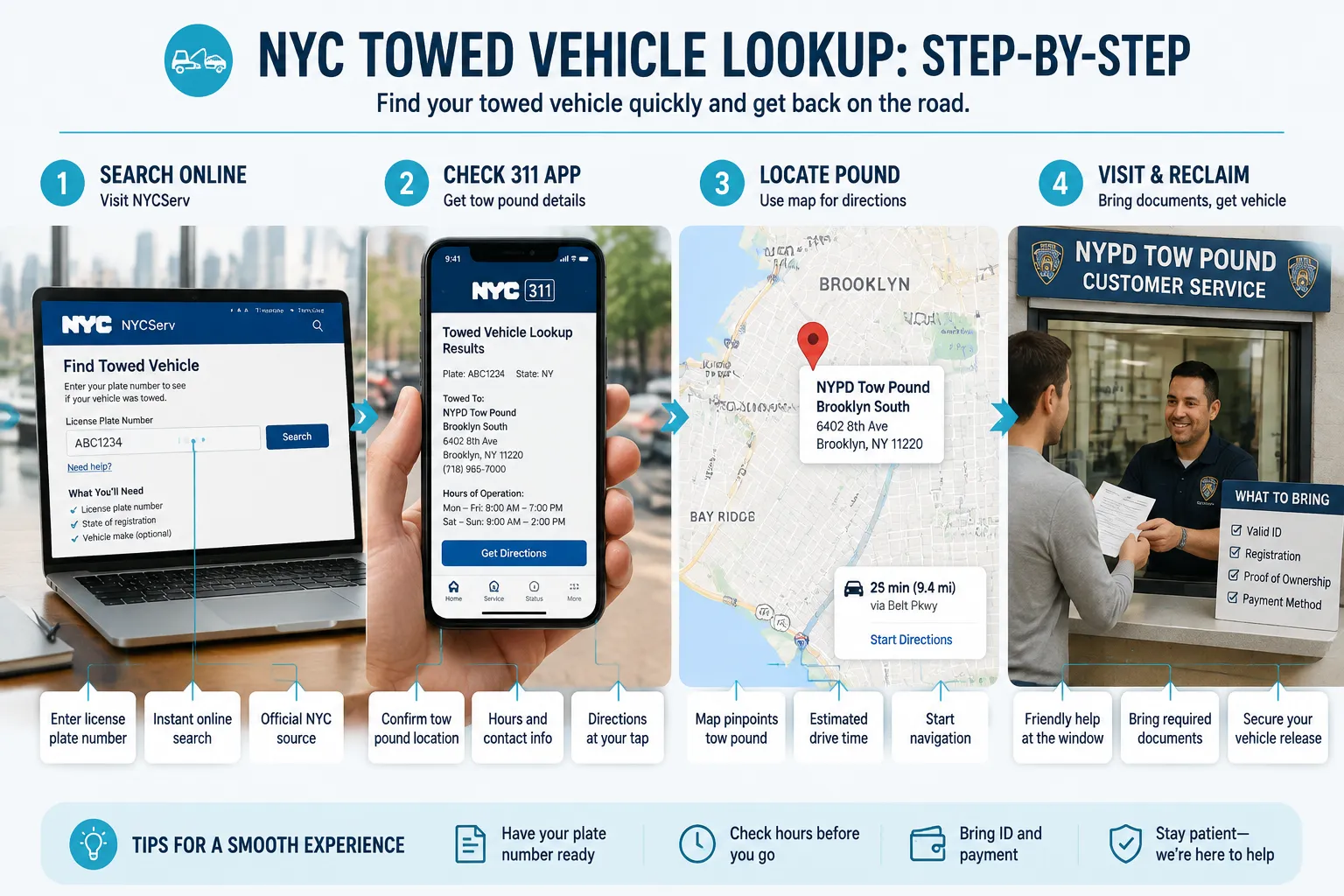
    • Use the official NYCServ Find Towed Vehicle tool with your license plate, state, and vehicle type to confirm tow status and pound location instantly.
    • Call 311 or visit NYC311 online if your vehicle doesn’t appear in the system, it may have been relocated rather than impounded.
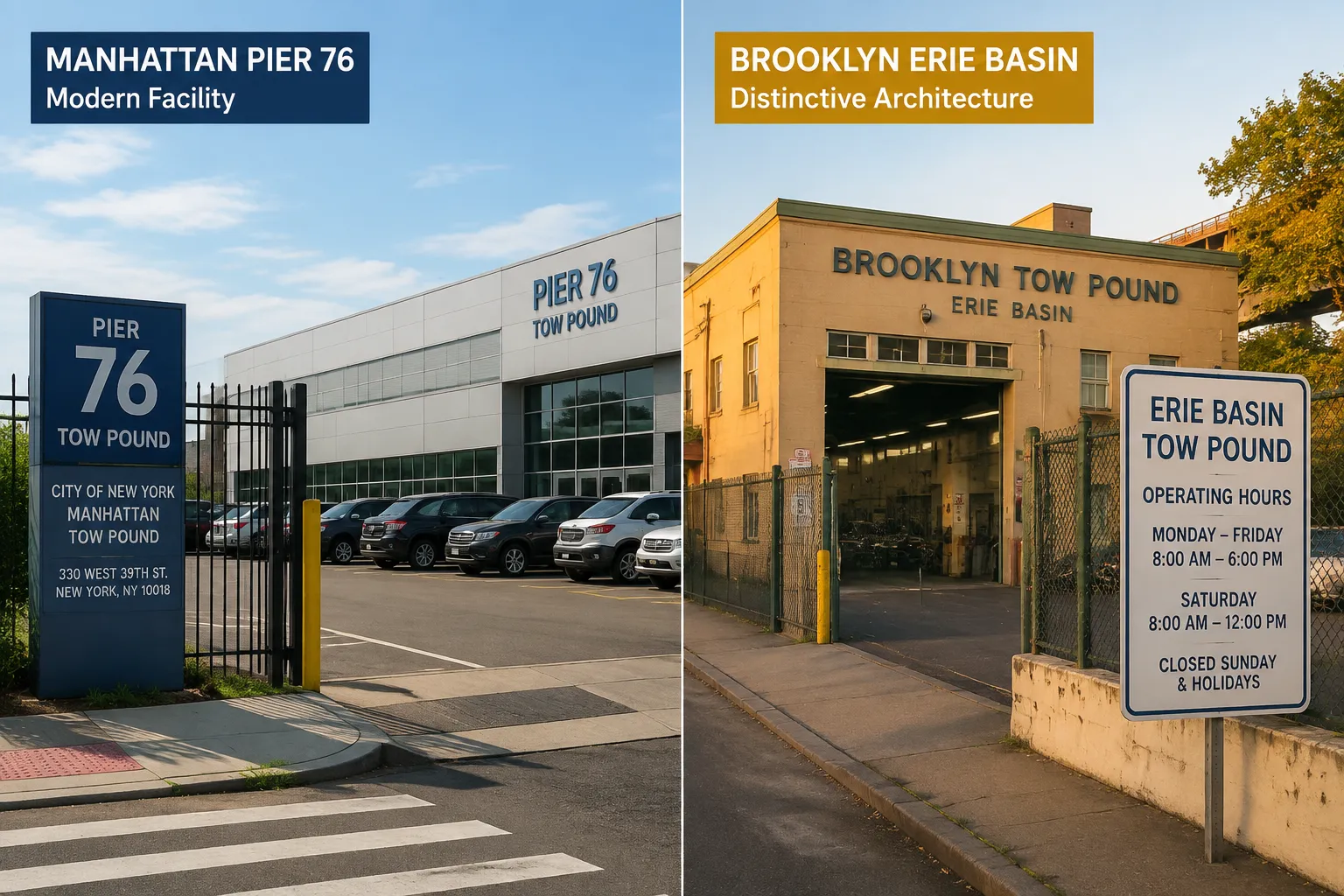
    • NYPD tow pounds operate in the Bronx, Brooklyn, Queens, and Manhattan (Pier 76), with varying hours; Manhattan’s Pier 76 is open nearly 24/7.
    • Bring your driver’s license, vehicle registration, and a credit card or cash to pay towing and storage fees at the pound.
    • Vehicles towed as evidence or after serious collisions go to separate NYPD Property Clerk auto pounds with restricted weekday-only access.

    Official NYC Towed Vehicle Lookup: Start Here to Find a Towed Vehicle NYC

    The fastest, most reliable way to find a towed vehicle NYC is the NYCServ Find Towed Vehicle online tool.[1][2] This official city service searches all NYPD, Department of Finance, marshal, and sheriff tow records in real time.

    How to use the NYCServ tool:

    1. Visit the NYCServ Find Towed Vehicle page.
    2. Enter your license plate number exactly as it appears.
    3. Select your state of registration from the dropdown.
    4. Choose your vehicle type: passenger car, commercial vehicle, taxi, motorcycle, or other.
    5. Click «Search.»

    If your vehicle was towed, the results display which pound holds it, the pound’s address, phone number, and operating hours.[1][8] You can then call ahead to confirm fees and required documents.

    Official NYC Towed Vehicle Lookup: Start Here to Find a Towed Vehicle NYC

    If your vehicle doesn’t appear: Call 311 immediately or use the NYC311 mobile app.[3][7] Provide your plate number, state, exact cross streets where you parked, borough, and the approximate time you last saw the car. The 311 operator can check additional databases and confirm whether the vehicle was relocated (moved a few spaces by police) rather than towed to a pound.[3][15]

    For comprehensive parking guidance and Real-Time Status updates on Alternate Side Parking, check suspension calendars to avoid future towing.

    NYPD Tow Pound Locations, Hours, and What to Bring

    Once you confirm your vehicle’s pound location, plan your visit carefully. Each borough’s NYPD tow pound has distinct hours and procedures.[4][13]

    Borough-by-Borough Pound Details

    Manhattan, Pier 76 (West 38th Street at 12th Avenue)

    • Hours: 7:00 a.m. Monday through 5:00 a.m. Sunday (essentially 24/6 operation; closed only 5:00 a.m. Sunday to 7:00 a.m. Monday).[13][8]
    • Phone: Check the official NYPD Towed Vehicles page for current contact.
    • Notes: Busiest pound; longest weekend hours; accessible by public transit and taxi.

    Bronx, 3880 Bronx Boulevard

    • Hours: Typically weekdays and Saturdays, daytime to early evening; closed Sundays.[13][9]
    • Phone: Listed on NYPD site.

    Brooklyn, Erie Basin Auto Pound (Columbia Street)

    • Hours: Weekdays and Saturdays, daytime hours; closed Sundays.[13][9]
    • Phone: Listed on NYPD site.

    Queens, 129-01 31st Avenue (College Point)

    • Hours: Weekdays and Saturdays, daytime hours; closed Sundays.[13][9]
    • Phone: Listed on NYPD site.

    For the most current addresses, phone numbers, and holiday closures, always consult the official NYPD Towed Vehicles page.[4]

    Borough-by-Borough Pound Details

    What to Bring to Retrieve Your Vehicle

    Required documents:[2][3][8]

    • Valid driver’s license (must match the name on the registration or rental agreement).
    • Vehicle registration or rental agreement.
    • Proof of insurance (often requested).
    • Payment method: credit card, debit card, or cash. Towing fees typically start around $185, plus $20 per day storage after the first day.[8][9]

    For rental cars: Bring your rental agreement and the credit card used to book the rental. The rental company may require you to notify them before retrieval.[15]

    For commercial vehicles: Additional paperwork (TLC license, commercial registration) may be required.

    Towing & Impounds: Evidence and Collision Vehicles

    Vehicles towed as evidence or after serious collisions are held at separate NYPD Property Clerk auto pounds, not the standard borough pounds.[4][14]

    Property Clerk Auto Pound Locations:

    • Brooklyn: Columbia Street facility (separate from the Erie Basin tow pound).
    • Queens: Springfield Gardens facility near JFK Airport.

    Hours: Monday through Friday, 8:00 a.m. to 3:00 p.m., excluding holidays.[14] Public access is restricted; you may need a release from the investigating officer or detective.

    If your vehicle was involved in an accident and doesn’t appear in the NYCServ tool, contact the precinct that handled the accident report to determine whether it was towed or relocated.[7] For more guidance on Towing & Impounds procedures, explore the Parking Education Hub.

    Avoid Fines and Towing: Real-Time Alternate Side Parking Status

    The best way to find a towed vehicle NYC is to never have it towed in the first place. Most NYC tows result from Alternate Side Parking violations during street cleaning.[6][9]

    Check Real-Time Status daily:

    • Visit Park Rules Live for live ASP suspension calendars and alerts.
    • Sign up for push notifications when street cleaning is suspended due to holidays or snow emergencies.
    • Review neighborhood-specific rules in Brooklyn, Queens, the Bronx, and Manhattan.

    Other common towing triggers:

    For hyper-local ASP rules, check Yonkers Alternate Side Parking and Mount Vernon Alternate Side Parking if you park outside the five boroughs.

    What to Do If Your Car Was Relocated, Not Towed

    Sometimes NYPD officers move a vehicle a few spaces or around the corner to facilitate emergency access, construction, or filming, without towing it to a pound.[3][6] This is called a «relocation.»

    Steps to find a relocated vehicle:

    1. Walk a two-block radius around where you parked, checking side streets and nearby blocks.
    2. Call 311 and provide your plate, state, exact cross streets, and borough. The operator can check relocation logs.[3][15]
    3. Contact the local precinct if 311 has no record. Precinct desk officers maintain relocation notes.[7]

    Relocated vehicles are not listed in the NYCServ towed-vehicle database, so always call 311 if the online search returns no results.[3][7]

    Tickets & Disputes: Challenge Unfair Parking Citations

    If you believe your vehicle was towed unjustly, for example, during a posted ASP suspension or from a spot with unclear signage, you can dispute both the towing fee and any associated parking tickets.[2][3]

    How to dispute:

    • Visit the NYC Department of Finance Parking Violations Bureau online portal.
    • Submit photos of signage, proof of ASP suspension, or evidence of a malfunctioning meter.
    • Reference the exact date, time, and location.
    • Request a hearing or submit a written appeal.

    For step-by-step guidance, explore the Tickets & Disputes section of the Parking Education Hub. Fighting unfair citations can save hundreds of dollars and prevent points on your license.

    Off-Street Parking: Avoid Future Tows with Garage Savings

    If street parking feels too risky, especially during ASP enforcement or snow emergencies, consider monthly garage rates or daily off-street parking.[6][9]

    Find garage deals:

    Monthly garage contracts often cost less than a single towing incident plus storage fees, and you’ll never worry about ASP again.

    Conclusion

    Knowing how to find a towed vehicle NYC starts with the official NYCServ lookup tool and 311 support. Enter your license plate, state, and vehicle type to confirm tow status and pound location instantly. If your car doesn’t appear, call 311 to check relocation logs or contact the precinct that handled any accident report. Always bring your driver’s license, registration, and payment to the pound, and verify hours before you go, Manhattan’s Pier 76 operates nearly 24/7, but other borough pounds close on Sundays.

    Next steps:

    Stay informed, act fast, and recover your vehicle with minimal hassle.

    References

    [1] Pvo Find Towed Vehicle – https://nycserv.nyc.gov/NYCServWeb/PVO_Find_Towed_Vehicle.jsp [2] Services Towed Vehicles – https://www.nyc.gov/site/finance/vehicles/services-towed-vehicles.page [3] Article – https://portal.311.nyc.gov/article/?kanumber=KA-02055 [4] Towed Vehicles – https://www.nyc.gov/site/nypd/services/vehicles-property/towed-vehicles.page [5] Where Is My Towed Car – https://www.brownstoner.com/queens/news/where-is-my-towed-car/ [6] Car Towed Nyc – https://secretnyc.co/car-towed-nyc/ [7] How To Find My Towed Car Nyc – https://www.njnylawyers.com/blog/how-to-find-my-towed-car-nyc/ [8] Towed Car Nyc – https://www.cartowed.com/find-car-towed-by-city/towed-car-nyc/ [9] What To Do If Your Car Is Towed In Nyc – https://towtruck.nyc/blog/what-to-do-if-your-car-is-towed-in-nyc/ [13] NYPD Tow Pound Hours – (referenced from source [4]) [14] NYPD Property Clerk Auto Pounds – (referenced from source [4]) [15] Rental Car Towing Guide – (referenced from source [7])

  • How to Fight a Double Parking Ticket in NYC: Official 2026 Defense Guide

    How to Fight a Double Parking Ticket in NYC: Official 2026 Defense Guide

    New York City issued over 10 million parking tickets in 2025, and double parking violations, carrying fines up to $115, remain among the most contested citations. Understanding how to fight a double parking ticket in NYC can save drivers hundreds of dollars and protect their driving records from unnecessary penalties.

    Double parking enforcement has intensified across all five boroughs in 2026, with automated camera enforcement now targeting bus routes and commercial corridors. Whether you received a traditional officer-issued citation or a camera-generated ticket, specific legal defenses and procedural strategies can overturn unfair parking citations when applied correctly.

    Key Takeaways

    • Double parking tickets (Violation Code 46) carry base fines of $115 in most NYC zones, with higher penalties in Midtown Manhattan commercial districts
    • Official disputes must be filed within 30 days through NYC Department of Finance online portal or in-person hearings
    • Successful defenses focus on technical errors, photographic evidence contradicting the violation, or proof the vehicle was not actually double parked
    • Automated Camera Enforcement (ACE) for double parking on bus routes requires different defense strategies than officer-issued tickets
    • Real-Time Status tools and suspension calendars help avoid fines but rarely provide valid defenses for existing double parking violations

    Understanding Double Parking Violations in NYC

    Double parking occurs when a vehicle parks alongside another already-parked vehicle, blocking traffic flow. Under NYC Traffic Rules, Violation Code 46 specifically prohibits standing or parking a vehicle on the roadway side of any vehicle stopped or parked at the curb [7].

    The legal definition extends beyond simply parking next to another car. Double parking includes:

    • Parking parallel to a vehicle at the curb, even briefly
    • Stopping in a travel lane while another parking option exists
    • Blocking a traffic lane regardless of whether other vehicles are present
    • Commercial vehicles double parking outside designated loading zones

    Current Fine Structure (2026)

    Base fines for double parking violations stand at $115 in most NYC zones [5]. Midtown Manhattan commercial districts impose higher penalties during peak hours. The stipulated fine program allows eligible drivers to pay reduced amounts if they resolve tickets quickly, but accepting stipulated fines waives your right to contest the violation [5].

    Fines increase significantly for repeat offenders. Unpaid tickets generate additional penalties and can lead to vehicle booting or towing. Check your ticket status immediately using the official NYC parking violation lookup tool.

    Understanding Double Parking Violations in NYC

    Automated Camera Enforcement Expansion

    NYC deployed Automated Camera Enforcement (ACE) systems along Select Bus Service routes starting in 2024. These cameras automatically photograph vehicles double parked in bus lanes and generate violations without officer intervention. Camera-issued tickets require different defense approaches than traditional citations, particularly regarding photographic evidence standards.

    How to Fight a Double Parking Ticket in NYC: Step-by-Step Process

    Fighting a double parking ticket requires following specific procedures and deadlines established by the NYC Department of Finance. Missing these deadlines forfeits your right to dispute.

    Step 1: Review Your Ticket Immediately

    Examine every detail on your parking violation notice:

    • Violation code (should be 46 for double parking)
    • Date and time of violation
    • Exact location with street address
    • Vehicle plate number and state
    • Issuing officer or camera identification
    • Fine amount

    Document any errors. Incorrect plate numbers, wrong dates, or location mistakes provide grounds for dismissal [1].

    Step 2: Gather Evidence Within 30 Days

    You have 30 days from the ticket issue date to file a dispute [1]. Collect supporting documentation:

    • Photographs showing your vehicle’s actual position
    • Time-stamped images proving you were not double parked
    • Witness statements from passengers or nearby individuals
    • GPS or dashcam footage showing vehicle location
    • Receipts or records proving you were elsewhere
    • Street signage photos showing confusing or contradictory parking rules

    Take multiple photos from different angles. Include landmarks, street signs, and other parked vehicles for context. Photograph the entire block to demonstrate available parking and traffic conditions.

    Step 3: Choose Your Dispute Method

    NYC offers three official dispute channels [1][2]:

    Online Dispute (Fastest)

    Submit disputes through the NYC Department of Finance website. Online filing provides:

    • 24/7 submission availability
    • Immediate confirmation receipt
    • Digital evidence upload (photos, documents)
    • Case status tracking
    • Faster processing than mail or in-person options

    Access the online dispute portal at the official NYC Finance dispute page [1].

    In-Person Hearing

    Schedule a hearing at a Department of Finance Parking Violations Bureau location [2]. In-person hearings allow you to:

    • Present evidence directly to a hearing officer
    • Provide verbal testimony
    • Respond to questions about circumstances
    • Submit physical documents and photographs

    Request an in-person hearing when your defense requires detailed explanation or when you have witnesses. Arrive early with organized evidence and multiple copies of all documents.

    Mail Dispute

    Mail written disputes to the address printed on your ticket. Include:

    • Completed dispute form
    • Copies (never originals) of supporting evidence
    • Detailed written explanation
    • Contact information for follow-up

    Mail disputes take longest to process and offer no confirmation of receipt. Use certified mail with return receipt for proof of submission.

    Step 4: Build Your Defense Strategy

    Successful defenses for double parking tickets typically fall into these categories:

    Technical and Procedural Defenses

    • Incorrect vehicle information (wrong plate, make, model, color)
    • Wrong violation location listed
    • Ticket issued outside officer’s jurisdiction
    • Missing required ticket elements (signature, badge number)
    • Violation occurred on a date/time you can prove vehicle was elsewhere

    Factual Defenses

    • Vehicle was legally parked at curb, not double parked
    • No other vehicle was present at the curb
    • You were parked in a legal loading zone during permitted hours
    • Emergency situation required stopping (medical emergency, vehicle breakdown)
    • Signage was missing, obscured, or contradictory

    Photographic Evidence Defenses (Camera Tickets)

    • Camera image does not clearly show your vehicle double parked
    • Photograph shows vehicle legally positioned
    • Image timestamp conflicts with actual events
    • Camera angle or quality prevents accurate determination

    Document everything. Hearing officers decide cases based on evidence, not verbal claims alone [6].

    How to Fight a Double Parking Ticket in NYC: Step-by-Step Process

    Common Defenses That Work (and Those That Don’t)

    Understanding which arguments succeed and which fail saves time and improves your chances of dismissal.

    Effective Defense Arguments

    Photographic Contradiction

    Submit clear photographs proving your vehicle was not double parked. Show your car properly positioned at the curb with no vehicle alongside it. Include multiple angles and timestamps matching the violation time [6].

    Location Error

    If the ticket lists an incorrect location and you can prove your vehicle was legally parked elsewhere at that time, the violation cannot stand. GPS data, parking receipts, or surveillance footage from the actual location provides strong evidence [4].

    Signage Issues

    Photograph missing, damaged, or contradictory parking signs at the violation location. If regulations were unclear or impossible to follow, you may have grounds for dismissal. Document the entire block’s signage to show confusion [9].

    Vehicle Identification Error

    Tickets issued to the wrong plate number, vehicle color, or make must be dismissed. Provide vehicle registration proving the discrepancy [10].

    Defenses That Rarely Succeed

    «I Was Only Stopped Briefly»

    Duration does not matter for double parking violations. Even momentary stops in a travel lane constitute violations. Hearing officers consistently reject «short stop» defenses [4][9].

    «I Had My Hazard Lights On»

    Activating hazard lights does not legalize double parking. This remains one of the most common misconceptions among NYC drivers [9].

    «I Was in the Vehicle»

    Occupied vehicles can still receive double parking tickets. Being present in your car does not exempt you from standing and parking regulations [4].

    «I Couldn’t Find Legal Parking»

    Lack of available parking never justifies double parking. NYC parking scarcity is not a valid legal defense [9].

    Alternate Side Parking Confusion

    Alternate Side Parking rules govern when you must move your vehicle for street cleaning, but ASP suspensions do not authorize double parking. Even on ASP suspension days, double parking remains illegal [3]. Check the live ASP status to avoid street cleaning tickets, but understand this does not relate to double parking violations [3].

    Special Considerations for Commercial Vehicles and Delivery Drivers

    Commercial vehicles face unique double parking challenges in NYC. Delivery drivers often have no legal alternative when making quick deliveries, yet double parking violations still apply.

    Commercial Loading Zone Rules

    Commercial vehicles may stop in designated loading zones during posted hours. Photograph loading zone signs and document your delivery timestamp to prove compliance. If ticketed while legally using a loading zone, this evidence supports dismissal [7].

    Midtown Manhattan Commercial Restrictions

    Midtown Manhattan enforces stricter double parking rules during commercial hours (7 AM – 7 PM weekdays). Fines increase in this zone. Commercial drivers should document any emergency circumstances or loading zone unavailability [5].

    Fleet and Repeat Offender Programs

    Commercial fleets with multiple violations may qualify for stipulated fine programs offering reduced penalties in exchange for quick payment [5]. Evaluate whether fighting individual tickets or accepting program terms better serves your situation.

    After You Submit Your Dispute

    Understanding the hearing process and timeline helps you prepare for outcomes.

    Processing Timeline

    Online disputes typically receive decisions within 30-90 days. In-person hearings occur within 30-45 days of your request. Mail disputes take longest, often 60-120 days [1][2].

    Hearing Officer Review

    A Department of Finance hearing officer reviews all submitted evidence. They examine:

    • Ticket accuracy and completeness
    • Your evidence and documentation
    • Applicable NYC traffic rules
    • Officer testimony (if available)

    Hearing officers have broad discretion. Strong photographic evidence and clear documentation significantly improve dismissal chances [6].

    Possible Outcomes

    Dismissed

    The violation is dismissed entirely. You owe nothing and the ticket does not affect your record. This is your goal [10].

    Guilty

    The hearing officer finds the evidence supports the violation. You must pay the full fine plus any accumulated late fees. Payment is due within 30 days of the decision [10].

    Reduced Fine

    In some cases, hearing officers reduce fines while still finding a violation occurred. This outcome is less common for double parking than for other violation types.

    Appeal Process

    If your dispute is denied, you may appeal to the Appeals Board within 30 days of the decision [10]. Appeals focus on legal errors or procedural mistakes in the hearing process, not re-arguing facts. Consult the NYC Department of Finance appeals information for specific procedures [10].

    Preventing Future Double Parking Tickets

    The most effective strategy is avoiding violations entirely. Real-time tools and parking knowledge keep you compliant.

    Use Real-Time Parking Status Tools

    Monitor Alternate Side Parking status before parking on NYC streets. While ASP rules differ from double parking regulations, understanding street cleaning schedules helps you find legal spots [3].

    Check suspension calendars for holidays and special events when parking rules change. The 2026 ASP calendar lists all official suspension dates [3].

    Know Your Neighborhood Rules

    Parking regulations vary significantly across NYC neighborhoods. Yonkers, Mount Vernon, and other municipalities near NYC have different rules than the five boroughs. Familiarize yourself with local regulations wherever you park regularly.

    Find Off-Street Parking Options

    When street parking is unavailable, use off-street alternatives. Explore parking garages across all NYC boroughs for reliable, legal options. Compare rates and locations through the Parking Education Hub to find the best deals.

    Download Parking Management Apps

    Modern parking apps provide real-time availability, mobile payment, and violation alerts. These tools help you locate legal parking quickly and avoid costly tickets.

    Conclusion

    Understanding how to fight a double parking ticket in NYC requires knowledge of violation codes, evidence requirements, and dispute procedures. Success depends on gathering strong photographic evidence, identifying technical errors, and submitting disputes within the 30-day deadline.

    Focus your defense on factual contradictions, prove your vehicle was not actually double parked through clear photographs and documentation. Avoid common misconceptions like «short stops» or «hazard lights» that hearing officers consistently reject.

    Take Action Now

    • Review your ticket for errors immediately
    • Photograph the violation location from multiple angles
    • File your dispute within 30 days through the official NYC Finance portal
    • Organize all evidence before your hearing
    • Check Real-Time ASP Status to prevent future violations

    Explore the Parking Education Hub for comprehensive guides on Tickets & Disputes, understanding suspension calendars, and locating off-street parking across New York State. Avoid fines and towing by staying informed with accurate, real-time parking information.

    Fight unfair parking citations with confidence. Your evidence and knowledge of NYC parking regulations provide your strongest defense against unjust double parking tickets.

    References

    [1] Dispute Web – https://www.nyc.gov/site/finance/vehicles/dispute-web.page [2] Dispute Person – https://www.nyc.gov/site/finance/vehicles/dispute-person.page [3] Asp Calendar 2026 – https://www.nyc.gov/html/dot/downloads/pdf/asp-calendar-2026.pdf [4] New York City – https://parkingfight.com/cities/new-york-city [5] Stipulated Fines Fee Schedule – https://www.nyc.gov/assets/finance/downloads/pdf/tax_and_parking_program_operations/stipulated-fines-fee-schedule.pdf [6] How To Dispute – https://www.19pine.ai/parking-tickets/us/new-york/new-york-city/how-to-dispute [7] Services Violation Codes – https://www.nyc.gov/site/finance/vehicles/services-violation-codes.page [9] Nyc Parking Tickets – https://unscriptednewyork.com/nyc-parking-tickets/ [10] Dispute A Ticket Faqs – https://www.nyc.gov/site/finance/vehicles/dispute-a-ticket-faqs.page

  • The Complete Guide to Alternate Side Parking Rules NYC in 2026

    The Complete Guide to Alternate Side Parking Rules NYC in 2026

    New York City issues over 2 million alternate side parking tickets annually, generating more than $100 million in revenue. Every weekday morning, thousands of drivers scramble to move their vehicles before street sweepers arrive, or face costly citations and the nightmare of towing. Understanding alternate side parking rules NYC is not optional for city residents; it’s essential survival knowledge that protects your wallet and your time.

    Alternate side parking rules NYC exist for one purpose: to allow Department of Sanitation crews to clean city streets effectively. When ASP is in effect, you cannot park on the designated side during posted hours, even if the sweeper has already passed[8]. The regulations apply across all five boroughs, with specific schedules posted on street signs featuring the distinctive «P» with broom symbol. Violations carry steep fines, and repeat offenders risk towing and impounds.

    This guide provides real-time information on how alternate side parking rules NYC operate in 2026, including suspension calendars, grace periods, enforcement changes, and neighborhood-specific details. Check status daily to avoid fines and towing.

    Key Takeaways

    • ASP regulations require vehicles to move during posted hours for street cleaning, even after sweepers pass; violations result in tickets and potential towing
    • A 5-minute grace period applies citywide in 2026, giving drivers extra time past posted restrictions before citations can be issued
    • ASP suspensions occur on major legal and religious holidays, with the official 2026 calendar listing all scheduled dates; emergency suspensions happen for snow and severe weather
    • Parking meters remain in effect during most ASP suspensions, except on specific holidays like Independence Day and Sundays when meters are also suspended
    • New legislation passed in July 2026 restores DSNY authority to place large warning stickers on vehicles that ignore ASP rules

    Understanding Alternate Side Parking Rules NYC Basics

    Understanding Alternate Side Parking Rules NYC Basics

    Alternate side parking exists to facilitate street cleaning operations across New York City. The Department of Sanitation schedules regular sweeping routes, and ASP regulations force vehicles to relocate temporarily so crews can access curbs and gutters effectively[8].

    How to Read ASP Signs

    Official ASP signs display a «P» symbol with a broom icon. Each sign posts specific information:

    • Days of the week when restrictions apply
    • Time windows during which parking is prohibited
    • Which side of the street is affected

    The restriction applies for the entire posted period, regardless of whether the street sweeper has already passed your block[8]. Do not assume you can return early.

    The 5-Minute Grace Period Rule

    As of 2026, New York City enforces a mandatory 5-minute grace period for all alternate side parking zones[8]. This means:

    • Parking tickets cannot legally be issued until five minutes after the posted start time
    • Drivers have extra time to move vehicles without penalty
    • The grace period applies citywide and is codified in official 311 guidance

    Locate your vehicle and move it before the grace period expires. Traffic enforcement agents begin ticketing immediately after the window closes.

    When ASP Does Not Apply

    Alternate side parking rules NYC are not in effect on Sundays[8]. Additionally, drivers do not need to pay parking meters on Sundays citywide.

    ASP regulations are suspended on specific legal and religious holidays throughout the year, as well as during emergency declarations for snow operations or severe weather[1][5]. The official suspension calendar lists all scheduled dates, but always verify real-time status before assuming ASP is off.

    Official 2026 Alternate Side Parking Rules NYC Suspension Calendar

    Official 2026 Alternate Side Parking Rules NYC Suspension Calendar

    The New York City Department of Transportation publishes an annual suspension calendar that lists every scheduled date when alternate side parking rules NYC will not be enforced[1]. For 2026, the calendar was updated in late August and includes a comprehensive list of legal and religious holidays recognized by the city[1].

    Major Scheduled Suspensions in 2026

    ASP regulations are suspended on the following confirmed dates in 2026[8]:

    Date Holiday/Observance
    January 1 New Year’s Day
    January 6 Three Kings’ Day
    January 19 Martin Luther King Jr. Day
    February 12 Lincoln’s Birthday
    February 16 Washington’s Birthday/Presidents’ Day
    February 16-18 Lunar New Year observances
    February 18 Ash Wednesday, Losar
    March 3 Purim
    May 25 Memorial Day

    The full calendar extends through December and covers dozens of religious observances, including Christian, Jewish, Muslim, Hindu, and Buddhist holidays[5][8]. This reflects the city’s commitment to accommodating its diverse population.

    Emergency Weather Suspensions

    Beyond scheduled holidays, the city frequently suspends alternate side parking rules NYC for snow operations and severe weather[1]. In early 2026, DOT issued multiple emergency suspensions:

    • Through February 8: Extended suspension for ongoing snow removal[14]
    • February 11-12: Snow operations plus Lincoln’s Birthday[7]
    • Through February 14: Continued snow emergency[3]
    • March 2-3: Snow operations coinciding with Purim[6]

    These emergency suspensions are announced via official DOT press releases, social media, and the city’s 311 system. Real-time status updates are critical during winter months.

    How to Check Real-Time Status

    Suspension calendars provide scheduled dates, but emergency changes happen with little notice. Verify current status daily using these official channels:

    • Visit nyc.gov for DOT announcements
    • Call 311 for real-time confirmation
    • Use real-time ASP status tools for instant updates
    • Follow NYC DOT on social media for immediate alerts

    Never rely solely on the printed calendar. Weather emergencies and special events can trigger unscheduled suspensions at any time[1].

    Parking Meters During Suspensions

    Critical distinction: When alternate side parking rules NYC are suspended, parking meters typically remain in effect citywide[2][3][6][7]. You do not need to move your car for street cleaning, but you must still pay the meter.

    Exceptions exist for major federal holidays. On Independence Day 2026 (July 3-4), both ASP regulations and parking meters were suspended citywide[13]. Sundays are another exception: ASP never applies, and meters are free[8].

    Always confirm meter status on suspension days to avoid citations.

    Alternate Side Parking Rules NYC Across New York State

    While this guide focuses on New York City, alternate side parking regulations exist in municipalities across New York State. Each city maintains its own schedule, suspension calendar, and enforcement policies.

    Other New York Cities with ASP

    Drivers in these cities face similar street-cleaning regulations:

    Each municipality posts its own signs and maintains separate suspension calendars. Do not assume NYC rules apply elsewhere.

    Neighborhood-Specific NYC Rules

    Within New York City, certain neighborhoods experience higher ASP enforcement due to population density and limited off-street parking:

    Always read the specific sign on your block. Times and days vary by street.

    New Enforcement Changes: The Return of ASP Stickers in 2026

    In July 2026, the New York City Council passed Intro 92, restoring the Department of Sanitation’s authority to place large warning stickers on vehicles that fail to move during alternate side parking hours[10][11][12]. The measure passed by a 41-10 vote and reverses a ban that had been in place since approximately 2011-2012[10].

    How the Sticker Program Works

    Under the new legislation:

    • DSNY can affix stickers up to 8.5 by 11 inches on vehicle windows[10][11]
    • Stickers serve as high-visibility warnings to drivers who routinely ignore ASP rules
    • The program aims to improve compliance and street cleanliness, not increase fines[9]
    • Stickers complement traditional ticketing rather than replace it

    Council Member Gale Brewer’s office emphasizes that the goal is simply to get motorists to move their cars so sanitation crews can properly clean streets[9]. The visible stickers are intended to «shame» or strongly warn repeat violators[10][11].

    Implementation Timeline

    The bill was sent to Mayor Zohran Mamdani’s desk for consideration in early July 2026[4][9][12]. Full implementation depends on mayoral approval and subsequent agency rulemaking. Once active, drivers who ignore alternate side parking rules NYC may find large, difficult-to-remove stickers on their windshields in addition to traditional citations.

    Sanitation officials quoted in news coverage expect the program to improve compliance rates over time by creating a stronger deterrent than tickets alone[10].

    How to Avoid Alternate Side Parking Fines and Towing

    Alternate side parking violations carry financial penalties and the risk of vehicle impounds. Follow these strategies to protect yourself:

    Daily Status Checks

    Make checking ASP status part of your morning routine:

    • Use real-time status trackers for instant confirmation
    • Set calendar reminders for your street’s ASP days
    • Subscribe to city alerts for emergency suspensions
    • Check before bed if your ASP window starts early morning

    Understand the Full Time Window

    The posted time restriction applies for the entire period, even if the street sweeper has already passed[8]. Do not return your vehicle early. Wait until the posted end time plus the 5-minute grace period has fully elapsed.

    Know Your Suspension Calendar

    Download and print the official 2026 ASP suspension calendar[1]. Mark all scheduled holidays in your personal calendar. Remember that emergency weather suspensions can happen at any time, always verify real-time status.

    Explore Off-Street Parking Options

    When ASP enforcement is strict or you need guaranteed parking:

    Off-street parking eliminates ASP stress entirely and can be cost-effective for frequent violators.

    Fight Unfair Parking Citations

    If you receive an unjust ticket:

    • Document the scene with time-stamped photos
    • Review the posted sign carefully for discrepancies
    • Check whether ASP was officially suspended that day
    • File a dispute through NYC’s Parking Education Hub resources
    • Understand your rights regarding the 5-minute grace period[8]

    Many unfair parking citations can be successfully contested with proper documentation.

    Conclusion

    Alternate side parking rules NYC are non-negotiable for anyone who parks on city streets. The regulations exist to facilitate essential street cleaning operations, and violations result in costly tickets, potential towing, and now, as of 2026, large warning stickers on your windshield. Understanding the posted signs, the 5-minute grace period, and the official suspension calendar protects you from hundreds of dollars in annual fines.

    Take these actions immediately:

    • Check real-time ASP status before every parking decision
    • Download the official 2026 suspension calendar and mark all scheduled holidays
    • Set daily reminders for your street’s ASP days
    • Explore off-street parking options in your neighborhood for stress-free alternatives
    • Verify meter requirements on suspension days, meters usually remain in effect

    Stay informed. Verify status daily. Avoid fines and towing by treating alternate side parking rules NYC as the serious municipal requirement they are. Your wallet will thank you.

    References

    [1] Asp Calendar 2026 – https://www.nyc.gov/html/dot/downloads/pdf/asp-calendar-2026.pdf

    [2] Suspension Of Alternate Side Parking Regulations Feb 23 26 – https://www.nyc.gov/html/dot/html/pr2026/suspension-of-alternate-side-parking-regulations-feb-23-26.shtml

    [3] Suspension Of Alternate Side Parking Regulations Feb 12 26 – https://www.nyc.gov/html/dot/html/pr2026/suspension-of-alternate-side-parking-regulations-feb-12-26.shtml

    [4] Council Approves Bill To Sticker Alternate Side Parking Violators – https://ny1.com/nyc/all-boroughs/mornings-on-1/2026/07/08/council-approves-bill-to-sticker-alternate-side-parking-violators

    [5] Alternate Side Parking – https://www.nyc.gov/html/dot/html/motorist/alternate-side-parking.shtml

    [6] Suspension Of Alternate Side Parking Regulations Mar 01 26 – https://www.nyc.gov/html/dot/html/pr2026/suspension-of-alternate-side-parking-regulations-mar-01-26.shtml

    [7] Suspension Of Alternate Side Parking Regulations Feb 11 26 – https://www.nyc.gov/html/dot/html/pr2026/suspension-of-alternate-side-parking-regulations-feb-11-26.shtml

    [8] Article – https://portal.311.nyc.gov/article/?kanumber=KA-01011

    [9] Ignore Alternate Side Parking – https://council.nyc.gov/gale-brewer/2026/07/02/ignore-alternate-side-parking/

    [10] abc7ny – https://abc7ny.com/post/new-york-city-drivers-ignore-alternate-side-parking-rules-could-soon-get-sticker-courtesy-dsny/19425126/

  • NYC Handicap Parking Rules: Complete 2026 Guide to Permits, Violations & Enforcement

    NYC Handicap Parking Rules: Complete 2026 Guide to Permits, Violations & Enforcement

    New York City issued over 143,000 disability parking permits in 2025, yet thousands of drivers still receive citations each month for misunderstanding the complex dual-permit system. The confusion stems from a critical distinction: NYC operates two separate disability parking programs with completely different rules about where you can legally park.

    Understanding NYC handicap parking rules is essential for disabled drivers, caregivers, and anyone transporting someone with mobility limitations. The city’s unique regulatory framework differs significantly from the rest of New York State, and violations carry steep financial penalties plus the risk of towing.

    Key Takeaways

    • NYC requires a specific dashboard permit (NYC PPPD) for on-street parking privileges; the New York State blue hang tag works only in off-street lots within city limits
    • The NYC PPPD allows free parking at meters and in most «No Parking» zones, but never in «No Stopping» areas, bus stops, crosswalks, or within 15 feet of fire hydrants
    • Both permits require the disabled person to be present in the vehicle when using accessible parking privileges
    • Violations for illegal use of disability parking spaces range from $50-$150, with higher penalties for repeat offenses
    • The State blue hang tag now remains valid for up to five years, reducing renewal frequency for many permit holders

    Understanding NYC’s Dual Disability Parking Permit System

    Understanding NYC's Dual Disability Parking Permit System

    New York City operates a unique two-tier system that confuses even longtime residents. The NYC Parking Permit for People with Disabilities (PPPD) is a rectangular dashboard card that grants on-street parking privileges throughout the five boroughs.[1][4] This permit is issued exclusively by NYC DOT and is valid only within city limits.

    The New York State blue hang tag serves a completely different purpose. This placard, issued by the NYS DMV, allows parking in designated accessible spaces at off-street facilities, shopping malls, office buildings, apartment complexes, and university campuses.[2][3] Within NYC, the State hang tag cannot be used for on-street parking at meters or in street-cleaning zones.

    This dual system exists because NYC does not designate reserved handicapped spaces on public streets. The city reserves signed accessible parking exclusively for off-street lots and garages.[2][8] For curbside parking, disabled drivers must use the NYC PPPD and follow specific regulations about where that permit grants privileges.

    Both permits require proof of a permanent disability that seriously impairs mobility. Non-drivers, including children with qualifying disabilities, can receive permits that allow their caregivers to use parking privileges when transporting them.[3][6]

    Check the NYC Parking Directory to locate accessible off-street parking facilities across all five boroughs.

    Where the NYC PPPD Allows You to Park

    The NYC dashboard permit grants specific on-street parking privileges that override many standard restrictions. Permit holders can park for free at any metered passenger or commercial space without time limits (unless a shorter time is posted on the specific meter).[1][15]

    The permit also allows parking in most «No Parking» zones, including areas marked with street-cleaning «broom» signs during Alternate Side Parking suspension periods. This exemption helps disabled drivers avoid the constant vehicle shuffling required by NYC’s street-cleaning schedule.[1][2]

    Additionally, NYC PPPD holders may park in many «Authorized Vehicles Only» spaces, such as those designated for diplomats, press vehicles, and government agency cars, subject to any posted time restrictions.[1][15]

    Critical Restrictions That Still Apply

    Critical Restrictions That Still Apply

    Even with a valid NYC PPPD, parking remains strictly prohibited in:[1][5][15]

    • «No Stopping» zones at any time
    • Most «No Standing» zones (except specific authorized-vehicle or truck-loading areas with explicit exemptions)
    • Hotel loading zones
    • Bus stops and bus lanes
    • Crosswalks and pedestrian ramps
    • Driveways and building entrances
    • Within 15 feet of fire hydrants
    • Double-parked positions or blocking traffic lanes

    These restrictions exist for public safety and traffic flow. Violations in these zones will result in tickets and potential towing, regardless of permit status.

    The NYC PPPD does not exempt holders from moving their vehicles during posted street-cleaning hours unless Alternate Side Parking has been officially suspended. Always verify the Real-Time Status of ASP rules before leaving your vehicle in a broom-sign zone.

    For accessible parking options in the Bronx, explore facilities like Sherman Parking and Parking in Bronx, NYC garages that offer designated accessible spaces.

    NYC Handicap Parking Rules: Eligibility & Application Process

    Eligibility for the NYC PPPD is limited to individuals with permanent disabilities that seriously impair mobility to the point where private automobile use is medically necessary.[3][4] Temporary conditions typically do not qualify.

    The application requires certification from a licensed physician, physician assistant, or nurse practitioner who can attest to the severity and permanence of the mobility impairment. The medical professional must complete specific sections of the application form documenting the disability.[4][6]

    Applications are submitted directly to NYC DOT through their dedicated parking permits portal at parkingpermits.nyc.gov. The department maintains specialized customer service staff to assist with applications, renewals, and resolving issues related to summonses or permit misuse investigations.[4][9]

    Processing times vary, but applicants should allow several weeks for review and permit issuance. The NYC PPPD must be renewed periodically, with the specific renewal cycle depending on the nature of the disability certification.

    For the State blue hang tag, applications go through the NYS DMV using form MV-664.1. As of August 2026, these placards remain valid for up to five years from the date of issue, significantly reducing the administrative burden of frequent renewals.[12]

    Find convenient Parking in Manhattan, NYC locations and Parking in Queens, NYC facilities with accessible spaces for State permit holders.

    Enforcement, Violations & Penalties Under NYC Handicap Parking Rules

    New York State law makes it a violation to stop, stand, or park in any area designated as handicapped parking without a valid disability permit or plates.[2][7] The law further requires that the person to whom the permit or plates were issued must be present in the vehicle when using reserved accessible spaces.

    This «presence requirement» is strictly enforced. Family members cannot use a relative’s disability permit when the disabled person is not in the vehicle. Doing so constitutes permit misuse and can result in permit revocation plus financial penalties.[6][15]

    Penalties for illegally parking in spaces reserved for people with disabilities typically range from $50-$75 for a first offense to $75-$150 for subsequent violations under state and city regulations.[3][5][7] Additional fines and towing fees apply when vehicles block accessible ramps or create safety hazards.

    Common Compliance Issues

    Recent legal aid resources updated in August 2026 highlight frequent mistakes:[6][15]

    • Misuse of permits by family members when the disabled person is absent
    • Parking in restricted «No Stopping» or «No Standing» zones despite having a permit
    • Confusing the NYC PPPD (valid on streets) with the State hang tag (off-street only in NYC)
    • Failing to display the permit properly or allowing it to expire

    If you receive what you believe is an unfair parking citation, document the circumstances immediately with photos showing your permit, the parking signs, and vehicle position. The Parking Education Hub provides resources for disputing Tickets & Disputes through NYC’s adjudication process.

    Check Parking in Brooklyn, NYC and Parking in Staten Island, NYC for additional accessible parking options across the outer boroughs.

    Future Changes: Proposed Statewide Permit Harmonization

    A 2025 New York State Assembly bill (A4611) proposes significant changes to disability parking rules. The legislation would clarify that disability parking permits issued by any city, town, or village would entitle vehicles to park in any designated disabled spaces statewide and in certain NYC «authorized parking spaces» referenced in the NYC Charter.[7]

    If enacted, this bill could gradually harmonize the currently fragmented rules across NYC and the rest of New York State. The proposal aims to reduce confusion for disabled drivers who travel between jurisdictions and simplify enforcement for municipal agencies.

    As of 2026, the bill remains under legislative review. Disabled drivers should monitor official NYC DOT and NYS DMV channels for updates on any regulatory changes that might affect permit validity or parking privileges.

    Conclusion

    Navigating NYC handicap parking rules requires understanding the critical distinction between the NYC PPPD dashboard permit for on-street parking and the New York State blue hang tag for off-street facilities. The NYC permit grants valuable exemptions from metered parking and many «No Parking» zones, but never overrides «No Stopping» restrictions, bus stops, or fire hydrant clearances.

    Take these steps now:

    • Verify which permit type you currently hold and where it’s valid
    • Check the Real-Time Status of Alternate Side Parking before leaving your vehicle in street-cleaning zones
    • Ensure the disabled person is present whenever using accessible parking privileges
    • Explore off-street parking options through the NYC Parking Directory to avoid fines and towing
    • Document your permit and parking circumstances if you receive a citation you believe is unfair

    Understanding these regulations protects you from costly violations while ensuring accessible parking resources remain available for those who genuinely need them. Stay informed about suspension calendars and municipal updates to avoid fines and towing throughout 2026.

  • What Does No Standing Mean in NYC?

    What Does No Standing Mean in NYC?

    New York City issues more than 10 million parking tickets every year, and a huge chunk of them come from drivers who thought they understood the rules. The phrase «No Standing» appears on thousands of street signs across all five boroughs, yet most drivers cannot explain what it actually means or how it differs from «No Parking.» Understanding what «No Standing» means in NYC is critical for anyone who drives, delivers goods, or hails a ride in the city.

    Key Takeaways

    • No Standing means you can stop only long enough to pick up or drop off passengers who are already waiting at the curb.
    • You cannot wait in your car, even with the engine running, in a No Standing zone.
    • No Standing is stricter than No Parking but less strict than No Stopping.
    • Violations carry fines starting at $115 in most Manhattan zones as of 2026.
    • Commercial drivers and ride-share operators face the highest risk of tickets in No Standing zones.

    What Does No Standing Mean in NYC? The Official Definition

    The New York City Department of Transportation defines «standing» as stopping your vehicle and waiting, whether or not you leave the car [2]. In a No Standing zone, you may stop only to pick up or drop off a passenger who is immediately ready to enter or exit your vehicle [6]. The moment you wait for someone to arrive, load luggage, or finish a phone call, you are violating the rule.

    This definition comes directly from NYC traffic regulations and applies 24 hours a day unless the sign specifies certain hours [7]. Many drivers assume that keeping the engine running or staying in the driver’s seat makes waiting legal. It does not. Waiting counts as standing, and standing is prohibited [10].

    What Does No Standing Mean in NYC? The Official Definition

    How No Standing Differs from No Parking and No Stopping

    New York uses three similar terms that confuse nearly everyone: No Stopping, No Standing, and No Parking. Each has a specific legal meaning, and the differences matter when an enforcement agent writes a ticket [3].

    No Stopping is the strictest rule. You cannot stop your vehicle for any reason except to avoid a crash or obey a traffic signal [6]. Even a quick passenger drop-off is illegal in a No Stopping zone.

    No Standing is the middle tier. You may stop briefly to pick up or drop off passengers, but you cannot wait in the vehicle [8]. Loading or unloading cargo is not allowed unless a separate sign permits commercial loading.

    No Parking is the most flexible. You can stop to actively load or unload passengers or cargo, and you can wait in the car while doing so [9]. You just cannot leave the vehicle unattended or park for an extended period.

    The hierarchy is simple: No Stopping is stricter than No Standing, and No Standing is stricter than No Parking [3]. Knowing this order helps you make quick decisions when you see a sign.

    Common Scenarios: What You Can and Cannot Do

    Real-world situations reveal how the rule works in practice. If you drive for a ride-hail service and stop in a No Standing zone to wait for a passenger who texted «be right down,» you are violating the rule [4]. The law requires the passenger to be at the curb before you stop.

    Delivery drivers often ask whether they can stop in a No Standing zone to unload packages. The answer is no, unless a separate sign explicitly permits commercial loading during certain hours [5]. Many No Standing zones in Manhattan prohibit all standing except during narrow time windows for deliveries.

    Parents picking up children from school frequently receive tickets in No Standing zones because they arrive early and wait [10]. The correct approach is to circle the block or find legal parking until the child is visible and ready to enter the car.

    Taxi and for-hire vehicle operators face strict enforcement in No Standing zones near airports, hotels, and transit hubs [6]. These high-traffic areas use No Standing rules to keep vehicles moving and prevent congestion.

    Where No Standing Zones Are Most Common in NYC

    No Standing signs appear throughout New York City, but certain locations have heavy concentrations. Midtown Manhattan, especially near Penn Station and Grand Central Terminal, has extensive No Standing zones to manage commuter and tourist traffic [2].

    Major commercial corridors in Brooklyn, Queens, and the Bronx also feature No Standing restrictions during business hours to facilitate deliveries and prevent double-parking [5]. If you’re searching for parking in Manhattan or parking in Queens, you’ll notice that legal street parking often requires understanding these signs.

    Bus stops, fire hydrants, and crosswalks almost always have No Standing rules, even if no sign is posted [7]. In some cases, the curb is painted red or yellow to reinforce the restriction.

    Neighborhoods with alternate side parking rules often combine No Standing restrictions with street-cleaning schedules. Drivers in areas like Greenpoint or Park Slope must check both the No Standing hours and the alternate side parking calendar to avoid tickets.

    Where No Standing Zones Are Most Common in NYC

    Fines, Enforcement, and How to Avoid Tickets

    As of January 2026, a No Standing violation in Manhattan’s Midtown core costs $115 [7]. In other parts of the city, the fine is typically $95. If your violation blocks a bike lane, bus stop, or crosswalk, the fine can exceed $150.

    Enforcement is aggressive in high-traffic zones. Traffic agents, NYPD officers, and automated camera systems all issue No Standing tickets [5]. Camera enforcement has expanded significantly in 2026, especially near bus lanes and school zones.

    To avoid tickets, follow these steps:

    • Read every sign carefully before you stop. Look for time restrictions and day-of-week rules.
    • Never wait in a No Standing zone, even for «just a minute.»
    • Use legal parking facilities when you need to wait. Check resources like parking in the Bronx or parking in Brooklyn to find nearby garages.
    • If you receive a ticket you believe is unfair, you can dispute it through the city’s online portal. Learn more in our guide to parking ticket disputes.

    Commercial drivers should plan routes that include legal loading zones. Many delivery companies now use apps that show real-time loading zone availability and alternate side parking status to minimize violations.

    Using Tools and Resources to Stay Compliant

    Staying on top of NYC parking rules requires access to current information. The city suspends alternate side parking on holidays, which can affect No Standing enforcement in some zones. Tools that provide live alternate side parking status help drivers know when rules are in effect.

    If your car is towed from a No Standing zone, act quickly. Our guide to finding your towed car in NYC walks you through the retrieval process and explains how to minimize storage fees.

    Mobile apps and online lookup tools now offer real-time alerts about parking rules, garage rates, and towing and impound information. Many drivers in cities like Buffalo and Albany use these tools to navigate complex local regulations.

    For frequent drivers, bookmarking a best parking apps guide can save time and money. These apps compare garage rates, show available spots, and send reminders about street-cleaning schedules.

    Conclusion

    Understanding what «No Standing» means in NYC is essential for every driver who navigates the city’s streets. The rule is simple in theory: you can stop only to pick up or drop off a passenger who is immediately ready, and you cannot wait. In practice, thousands of drivers receive tickets every week because they misunderstand or ignore this restriction.

    The key to compliance is reading signs carefully, never waiting in No Standing zones, and using legal parking or loading areas when you need more time. Fines are steep, enforcement is constant, and the rules apply around the clock unless a sign says otherwise.

    Take action today by reviewing the parking signs in the areas you drive most often. Use online tools to check alternate side parking schedules, find nearby garages, and set up alerts for rule changes. If you receive a ticket, explore your dispute options promptly. Staying informed and proactive will save you money, time, and frustration on New York City’s busy streets.

    References

    [1] Can Anyone Explain This Sign For Me – https://www.reddit.com/r/AskNYC/comments/2g9rg4/can_anyone_explain_this_sign_for_me/

    [2] Parking Regulations Sign Legend – https://www.nyc.gov/html/dot/downloads/pdf/parking-regulations-sign-legend.pdf

    [3] What Difference Between No Parking No Standing And No Stopping – https://nysltap.org/nysltap-local-roads/what-difference-between-no-parking-no-standing-and-no-stopping

    [4] 18d94d46610696f8d89d43f69d031d67 – https://www.oreateai.com/blog/decoding-nycs-parking-signs-no-standing-vs-no-parking-explained/18d94d46610696f8d89d43f69d031d67

    [5] Meaning No Standing – https://newyorkparkingticket.com/meaning-no-standing/

    [6] No Parking Vs No Standing Vs No Stopping Signs – https://www.newyorksafetycouncil.com/articles/no-parking-vs-no-standing-vs-no-stopping-signs/

    [7] 0 0 0 63770 – https://codelibrary.amlegal.com/codes/newyorkcity/latest/NYCrules/0-0-0-63770

    [8] No Parking Vs No Standing Vs No Stopping Signs 2 – https://blog.americansafetycouncil.com/no-parking-vs-no-standing-vs-no-stopping-signs-2/

    [9] What Is The Difference Between Stopping Standing Parking In Nyc – https://newyorkparkingticket.com/what-is-the-difference-between-stopping-standing-parking-in-nyc/

    [10] Nyc Parking Signs Decoded Alternate Side Parking No Standing No Stopping – https://www.vmaredriving.com/blog/nyc-parking-signs-decoded-alternate-side-parking-no-standing-no-stopping